UNITED STATES
SECURITIES AND EXCHANGE COMMISSION
Washington, D.C. 20549
SCHEDULE 14A
PROXY STATEMENT PURSUANT TO SECTION 14(a) OF THE SECURITIES
EXCHANGE ACT OF 1934
(Amendment No. )
Filed by the Registrant ý
Filed by a Party other than the Registrant o
Check the appropriate box:
o Preliminary Proxy Statement
o Confidential, for Use of the Commission Only (as permitted by Rule 14a-6(e)(2))
ý Definitive Proxy Statement
o Definitive Additional Materials
o Soliciting Material Pursuant to §240.14a-12
(Name of Registrant as Specified In Its Charter)
(Name of Person(s) Filing Proxy Statement, if other than the Registrant)
Payment of Filing Fee (Check the appropriate box):
ý No fee required.
o Fee paid previously with preliminary materials.
o Fee computed on table in exhibit required by Item 25(b) per Exchange Act Rules 14a-6(i)(1) and 0-11.
Dear Fellow Pilgrim’s Stockholders:
Throughout 2025, our team embraced a leadership mindset to accelerate the implementation of our strategies. We continued to emphasize team member safety and wellbeing, strengthened our focus on quality and service, and advanced innovation. Given these efforts, we delivered another year of strong results, while building the foundation for further profitable growth.
In the U.S., the relative affordability and convenience of chicken continued to resonate with consumers across both the retail and foodservice channels. Demand from our Key Customers in Case Ready increased more than twice the category average. Small Bird also experienced strong momentum as growth from QSRs was over 30% higher than the overall channel. In Big Bird, operational excellence efforts drove new performance milestones in yield, labor efficiency, and productivity.
Prepared Foods growth continued to accelerate as sales rose over 20% compared to last year. Within the frozen fully cooked category, Just Bare® maintained its leadership in velocity among all branded offerings as retail sales rose over 50% compared to last year. Equally important, we continued to strengthen and diversify our portfolio through brand development. Just Bare® reached one billion dollars in retail sales across fresh and fully cooked, achieving 13% market share in just three years.
In Europe, our strategies continued to drive progress. We cultivated multiple Key Customer partnerships through long-term agreements for differentiated, higher attribute chicken and pork offerings. Growth in our Fridge Raiders® and Rollover® brands outpaced category averages. For our Richmond® brand, we cultivated the foundation to reinvigorate growth through investments in new product development, brand awareness, and promotional activity. Innovation also accelerated as over 2,000 new items were launched to meet evolving marketplace needs and consumer preferences. In addition, we continued to drive efficiencies with further progress in manufacturing network optimization and back-office consolidation. Our efforts continue to be commended throughout the marketplace as we were recognized as the Food Manufacturer Of the Year in the most recent edition of the Food Manufacture Excellence Awards.
Mexico delivered solid performance despite a volatile live commodity market during the year. Key Customer partnerships in Fresh continued to grow, and Prepared Foods expanded its presence across retail, food service and QSR. Momentum for branded offerings continues to strengthen as overall sales rose nearly 9% compared to last year.
We continue to invest in our global portfolio to drive growth, enhance margins, and reduce volatility. In the U.S., we began construction of a new fully cooked processing facility in Walker County, Ga., to support our expansion of Prepared Foods, launched a series of projects in Big Bird to improve production efficiencies, and started the conversion of our Russellville facility to accelerate the growth with a retail Key Customer. In Mexico, efforts to develop national distribution capabilities in Fresh and support growth in value added remained on schedule. Given this work, we will have a more differentiated, resilient portfolio better equipped to meet consumer trends and navigate market dynamics.
Throughout these initiatives, we remained committed to generating shareholder value while maintaining the financial flexibility required to support future growth. To that end, we paid out nearly $2.0 billion of special dividends and maintained a net leverage ratio of less than 1.1X Adjusted EBITDA* (Earnings Before Interest, Taxes Depreciation and Amortization).
Sustainability remains a key pillar of our business. Operations reduced their direct and indirect emission intensity associated with processing compared to last year, and external agencies continued to recognize progress in environmental and social matters. Equally importantly, over 2,300 team members have signed up for our Better Futures program that provides tuition-free community college for Pilgrim’s team members and their children, and 780 have started their chosen academic pathway.
For fiscal year 2025, we had net sales of $18.5 billion, generating net income of $1.1 billion and GAAP EPS of $4.54. Our Adjusted EBITDA was $2.3 billion, or a 12.3% margin.
Moving forward, we will continue to execute with discipline and remain firmly grounded in our values, maintaining our commitment to team member safety and wellbeing along with the strategic priorities that drive our business. By staying focused on these fundamentals, we are well positioned to strengthen our performance in 2026 and beyond, advancing our ambition to be the best and most respected company in our industry.
Thank you for your continued support.
/s/ Fabio Sandri
Fabio Sandri
President and Global Chief Executive Officer, Pilgrim’s Pride Corporation
* For a reconciliation of this non-GAAP financial measure to the comparable GAAP measure, please see Annex A to this proxy statement.
Pilgrim’s Pride Corporation
1770 Promontory Circle
Greeley, Colorado 80634
NOTICE OF ANNUAL MEETING OF STOCKHOLDERS
To Be Held April 29, 2026
The annual meeting of stockholders of Pilgrim’s Pride Corporation will be held at Pilgrim’s Pride corporate headquarters, at 1770 Promontory Circle, Greeley, Colorado, on Wednesday, April 29, 2026, at 8:00 a.m., Mountain time, to consider and vote on the following matters:
1.To elect Gilberto Tomazoni, Wesley Mendonça Batista, Joesley Mendonça Batista, Andre Nogueira de Souza, Farha Aslam, Raul Padilla, Joanita Karoleski, and Wesley Mendonça Batista Filho as the eight JBS Directors;
2.To elect Wallim Cruz de Vasconcellos Junior and Arquimedes A. Celis as the two Equity Directors;
3.To conduct a stockholder advisory vote on executive compensation;
4.To ratify the appointment of KPMG LLP as our independent registered public accounting firm for 2026;
5.To vote on a stockholder proposal, if properly presented, to provide a report regarding internal diversity and inclusion policies and practices;
6.To vote on a stockholder proposal, if properly presented, to provide a political spending disclosure; and
7.To transact such other business as may properly be brought before the meeting or any adjournment thereof.
No other matters are expected to be voted on at the annual meeting.
The Board of Directors has fixed the close of business on March 19, 2026, as the record date for determining stockholders entitled to notice of, and to vote at, the annual meeting. If you owned shares of our common stock at the close of business on that date, you are cordially invited to attend the annual meeting. Whether or not you plan to attend the annual meeting, please vote at your earliest convenience. Most stockholders have three options for submitting their votes prior to the meeting:
(1) via the internet;
(2) by telephone; or
(3) by mail.
Please refer to the specific instructions set forth on the enclosed proxy card (if you are a stockholder of record) or voting instruction form (if you hold shares through a bank, broker or other nominee). Admission to the annual meeting will be limited to our stockholders, proxy holders and invited guests. If you are a stockholder of record, please bring a form of government-issued photo identification to the annual meeting. If you hold shares through a bank, broker or other nominee, please bring a form of government-issued photo identification and proof of beneficial ownership (such as a brokerage statement), and, if you wish to vote your shares in person, a signed legal proxy from the stockholder of record.
| FABIO SANDRI | |||||||||||
| Greeley, Colorado | President and | ||||||||||
| April 1, 2026 | Chief Executive Officer | ||||||||||
YOUR VOTE IS IMPORTANT!
PLEASE SIGN AND RETURN THE ACCOMPANYING PROXY CARD OR VOTING INSTRUCTION FORM OR VOTE YOUR SHARES ON THE INTERNET OR BY TELEPHONE BY FOLLOWING THE INSTRUCTIONS ON THE PROXY CARD OR VOTING INSTRUCTION FORM.
IMPORTANT NOTICE REGARDING THE AVAILABILITY OF PROXY MATERIALS FOR THE STOCKHOLDER MEETING TO BE HELD ON APRIL 29, 2026: The Proxy Statement and the 2025 Annual Report on Form 10-K are available at www.proxyvote.com. Enter the 16-digit control number located on the proxy card and click “Continue to Vote.”
TABLE OF CONTENTS
| Page | |||||
Pilgrim’s Pride Corporation
1770 Promontory Circle
Greeley, Colorado 80634
| PROXY STATEMENT | ||||||||
GENERAL INFORMATION
Why did I receive this proxy statement?
The Board of Directors (the “Board of Directors” or the “Board”) of Pilgrim’s Pride Corporation is soliciting stockholder proxies for use at our annual meeting of stockholders to be held at the Pilgrim’s Pride corporate headquarters, at 1770 Promontory Circle, Greeley, Colorado, on Wednesday, April 29, 2026, at 8:00 a.m., Mountain time, and any adjournments thereof (the “Annual Meeting” or the “meeting”). This proxy statement, the accompanying proxy card, and the 2025 Annual Report are being mailed to stockholders on or about April 1, 2026. Throughout this proxy statement, we will refer to Pilgrim’s Pride Corporation as “Pilgrim’s Pride,” “Pilgrim’s,” “PPC,” “we,” “us” or the “Company.”
What is the record date for the Annual Meeting and why is it important?
The Board of Directors has fixed March 19, 2026 as the record date for determining stockholders who are entitled to vote at the Annual Meeting (the “Record Date”). At the close of business on the Record Date, Pilgrim’s Pride had 237,921,941 shares of common stock outstanding, par value $0.01 per share.
What is the difference between holding shares as a stockholder of record and as a beneficial owner?
Most stockholders of Pilgrim’s Pride hold their shares through a broker, bank, or other nominee, rather than of record directly in their own name. As summarized below, there are some distinctions between shares held of record and those owned beneficially.
Stockholders of Record: If your shares are registered directly in your name with our transfer agent, you are considered a stockholder of record with respect to those shares. As a stockholder of record, you have the right to vote in person at the meeting.
Beneficial Owner: If your shares are held in a stock brokerage account or by a bank or other nominee, you are considered a beneficial owner of shares held in “street name.” As a beneficial owner, you have the right to direct your broker on how to vote your shares, and you are also invited to attend the meeting. Since you are not a stockholder of record, however, you may not vote your shares in person at the meeting unless you obtain a signed proxy from the holder of record giving you the right to vote the shares.
How do I attend and get admitted to the Annual Meeting?
You are entitled to attend the Annual Meeting only if you were a Pilgrim’s Pride stockholder as of the close of business on March 19, 2026 or if you hold a valid proxy for the Annual Meeting. If you plan to attend the physical meeting, please be aware of what you will need for admission as described below. If you do not provide a government-issued photo identification and comply with the other procedures described here for attending the Annual Meeting in person, you will not be admitted to the meeting location. We reserve the right to deny admission to any person who may pose a threat to the safety of stockholders or other meeting participants, and we reserve the right to implement additional procedures to ensure the security and safety of meeting attendees.
Stockholders of Record: If your shares are registered directly in your name with our transfer agent, your shares will be on a list maintained by the inspector of elections. You must present a government-issued photo identification, such as a driver’s license, state-issued ID card, or passport.
Beneficial Owner: If your shares are held in a stock brokerage account or by a bank or other nominee, you must provide proof of beneficial ownership as of the record date, such as an account statement or similar evidence
1
of ownership, along with a government-issued photo identification, such as a driver’s license, state-issued ID card, or passport.
For directions to the meeting, please contact our General Counsel at Pilgrim’s Pride Corporation, 1770 Promontory Circle, Greeley, Colorado 80634.
What is a proxy?
A proxy is your legal designation of another person (the “proxy”) to vote on your behalf. By completing and returning the enclosed proxy card, you are giving the proxies appointed by the Board and identified on the proxy card the authority to vote your shares in the manner you indicate on your proxy card.
What if I receive more than one proxy card?
You will receive multiple proxy cards if you hold shares of our common stock in different ways (e.g., joint tenancy, trusts, custodial accounts) or in multiple accounts. If your shares are held in “street name” (i.e., by a broker, bank or other nominee), you will receive your proxy card or voting instruction form from your nominee, and you must return your voting instruction form to that nominee. You should complete, sign, and return each proxy card or voting instruction form you receive.
What are the voting rights of the common stock?
Each holder of record of our common stock on the Record Date is entitled to cast one vote per share on each matter presented at the meeting.
What are the two categories of Directors?
The Company’s Amended and Restated Certificate of Incorporation (the “Certificate of Incorporation”) provides for a specified number of JBS Directors and Equity Directors, based upon the percentage ownership of JBS S.A. (“JBS”) in the Company.
JBS Directors are the eight Directors designated as JBS Directors pursuant to the terms of the Company’s Certificate of Incorporation or their successors nominated or appointed by the JBS Directors’ nominating committee (the “JBS Nominating Committee”). The current JBS Directors are Gilberto Tomazoni, Wesley Mendonça Batista, Joesley Mendonça Batista, Andre Nogueira de Souza, Farha Aslam, Raul Padilla, Joanita Karoleski, and Ajay Menon. Wesley Mendonça Batista Filho is a JBS Director nominee who, if approved, will replace Mr. Menon.
Equity Directors are the two Directors designated as Equity Directors pursuant to the terms of the Company’s Certificate of Incorporation or their successors nominated or appointed by the Equity Directors nominating committee (the “Equity Nominating Committee”) or any stockholders other than JBS and its affiliates (“Minority Investors”). The current Equity Directors are Wallim Cruz de Vasconcellos Junior and Arquimedes A. Celis.
What are the differences between the categories of Directors?
All of our Directors serve equal one-year terms. However, only JBS Directors can serve as members of the JBS Nominating Committee, and only Equity Directors can serve as members of the Equity Nominating Committee.
The Stockholders Agreement between us and an affiliate of JBS dated December 28, 2009 (as amended, the “JBS Stockholders Agreement”) requires JBS and its affiliates to vote all of Pilgrim’s Pride common stock that they hold in the same manner as the shares held by all Minority Investors with respect to the election or removal of Equity Directors. Consequently, the vote of the Minority Investors will determine the outcome of the election of Equity Directors.
With respect to all other matters submitted to a vote of holders of common stock, including the election or removal of any JBS Directors, JBS and its affiliates may vote shares of common stock held by them at their sole and absolute discretion.
2
What is the “Say-on-Pay” Vote?
With Proposal 3, the Board is providing stockholders with the opportunity to cast a non-binding, advisory vote on the compensation of our Named Executive Officers (“NEOs”) for 2025, as defined in “Compensation Discussion and Analysis”. This proposal, commonly known as a “Say-on-Pay” proposal, gives you, as a stockholder, the opportunity to endorse or not endorse our executive compensation programs and policies and the compensation paid to our NEOs in 2025.
How do I vote my shares?
If you are a “stockholder of record,” you have several choices. You can vote your proxy:
•via the internet;
•over the telephone; or
•by completing, dating, signing and mailing the enclosed proxy card.
Please refer to the specific instructions set forth on the enclosed proxy card.
If you are a stockholder of record, you also have the right to vote in person at the meeting. If you are a beneficial owner, your broker, bank or nominee will provide you with materials and instructions for voting your shares. In most instances, you will be able to do this on the internet, by telephone or by mail as indicated above. As a beneficial owner, you have the right to direct your broker on how to vote your shares. However, you may not vote your shares in person at the meeting unless you obtain a signed legal proxy from the holder of record giving you the right to vote the shares.
If you are a current or former employee of Pilgrim’s Pride who holds shares in either the Pilgrim’s Pride Corporation Retirement Savings Plan or the To-Ricos Employee Savings and Retirement Plan, your vote serves as a voting instruction to the trustee for these plans. To be timely, if you vote your shares in the Pilgrim’s Pride Corporation Retirement Savings Plan or the To-Ricos Employee Savings and Retirement Plan by telephone or internet, your vote must be received by 11:59 p.m., Mountain Time, on April 28, 2026. If you do not vote by telephone or internet, please return your proxy card as soon as possible. If you vote in a timely manner, the trustee will vote the shares as you have directed.
What are the Board’s recommendations on how I should vote my shares?
The Board recommends that you vote your shares as follows:
Proposal 1: FOR the election of all eight nominees for JBS Director.
Proposal 2: FOR the election of the two nominees for Equity Director.
Proposal 3: FOR the approval of the advisory vote on executive compensation.
Proposal 4: FOR ratification of the appointment of KPMG LLP as our independent registered public accounting firm for 2026.
Proposal 5: AGAINST the stockholder proposal to provide a report regarding internal diversity and inclusion policies and practices.
Proposal 6: AGAINST the stockholder proposal to provide a political spending disclosure.
3
What are my choices when voting?
With respect to:
Proposal 1: You may either (1) vote “FOR” the election of each JBS Director nominee; or (2) “WITHHOLD” your vote on each JBS Director nominee.
Proposal 2: You may either (1) vote “FOR” the election of each Equity Director nominee; or (2) “WITHHOLD” your vote on each Equity Director nominee.
Proposal 3: You may vote “FOR” or “AGAINST” the proposal, or you may elect to abstain from voting your shares. Abstaining will have the same effect as a vote against the proposal, as discussed below.
Proposal 4: You may vote “FOR” or “AGAINST” the proposal, or you may elect to abstain from voting your shares. Abstaining will have the same effect as a vote against the proposal, as discussed below.
Proposal 5: You may vote “FOR” or “AGAINST” the proposal, or you may elect to abstain from voting your shares. Abstaining will have the same effect as a vote against the proposal, as discussed below.
Proposal 6: You may vote “FOR” or “AGAINST” the proposal, or you may elect to abstain from voting your shares. Abstaining will have the same effect as a vote against the proposal, as discussed below.
How will my shares be voted if I do not specify my voting instructions?
If you sign and return your proxy card without indicating how you want your shares to be voted, the proxies appointed by the Board will vote your shares as follows:
Proposal 1: FOR the election of all eight nominees for JBS Director.
Proposal 2: FOR the election of the two nominees for Equity Director.
Proposal 3: FOR the approval of the advisory vote on executive compensation.
Proposal 4: FOR ratification of the appointment of KPMG LLP as our independent registered public accounting firm for 2026.
Proposal 5: AGAINST the stockholder proposal to provide a report regarding internal diversity and inclusion policies and practices.
Proposal 6: AGAINST the stockholder proposal to provide a political spending disclosure.
If you are a current or former employee of Pilgrim’s Pride who holds shares through the Pilgrim’s Pride Corporation Retirement Savings Plan or the To-Ricos Employee Savings and Retirement Plan, you will be given the opportunity to provide instruction to the trustee with respect to how to vote your shares. Any shares for which instructions are not received (1) will be voted by the trustee in accordance with instructions provided by Pilgrim’s Pride with respect to shares held under the Pilgrim’s Pride Corporation Retirement Savings Plan and (2) will not be voted with respect to shares held under the To-Ricos Employee Savings and Retirement Plan.
What is a quorum?
A “quorum” is necessary to hold the meeting. A quorum consists of a majority of the voting power of our common stock issued and outstanding and entitled to vote at the meeting, including the voting power that is present in person or by proxy. The shares of a stockholder whose ballot on any or all proposals is marked as “abstain” and shares represented by “broker non-votes” will be included in the number of shares present at the Annual Meeting to determine whether a quorum is present.
4
What vote is required to approve the proposals for the election of the JBS Directors and the Equity Directors?
Directors will be elected by a plurality of the voting power of the shares entitled to vote in the election of Directors and represented in person or by proxy at a meeting of stockholders at which a quorum is present. This means that the director who receives the most votes will be elected.
Because JBS owned or controlled over 50% of the voting power of our outstanding common stock on the Record Date, it will be able to elect all of the nominees for JBS Directors and determine the outcome of all other matters presented to a vote of the stockholders. The JBS Stockholders Agreement, however, requires JBS and its affiliates to vote all of Pilgrim’s Pride common stock owned by them in the same manner as the shares held by the Minority Investors with respect to Proposal 2. Consequently, the vote of the Minority Investors will determine the outcome of Proposal 2. With respect to approval of any other item of business to be voted upon at the meeting, including the election or removal of any JBS Directors, JBS and its affiliates may vote shares of Pilgrim’s Pride common stock held by them at their sole and absolute discretion.
What vote is required for advisory approval of executive compensation?
With regard to Proposal 3, the stockholder advisory vote on executive compensation, the results of this vote are not binding on the Board, meaning that our Board will not be obligated to take any compensation actions or to adjust our executive compensation programs or policies, as a result of the vote. Notwithstanding the advisory nature of the vote, the resolution will be considered passed with the affirmative vote of a majority of the total outstanding voting power of capital stock, present in person or represented by proxy at the Annual Meeting.
What vote is required for the approval of the appointment of KPMG LLP, the stockholder proposals and any other item of business to be voted upon at the meeting?
The affirmative vote of a majority of the total outstanding voting power of capital stock present in person or represented by proxy at the Annual Meeting is required to ratify the appointment of our independent registered public accounting firm, to approve the stockholder proposals and to approve any other item of business to be voted upon at the meeting.
How are abstentions treated?
Abstentions from voting on any matter will be counted in the tally of votes. Stockholders may only “withhold” votes and may not abstain with respect to the election of Directors in Proposals 1 and 2. However, stockholders may abstain from Proposals 3, 4, 5 and 6, and an abstention will have the same effect as a vote against any of these proposals.
How are “broker non-votes” treated?
A “broker non-vote” occurs when a nominee (a bank, broker, or other nominee) holding shares for a beneficial owner returns a proxy but does not vote on a particular proposal because the nominee does not have discretionary voting power for that particular item and has not received voting instructions from the beneficial owner. Under applicable rules, brokers have the discretion to vote such shares on routine matters, but not on non-routine matters. A broker non-vote will be deemed “present” at the Annual Meeting and will be counted for purposes of determining whether a quorum exists.
Your broker may vote your shares in its discretion without your instructions on Proposal 4, which is the only routine proposal to be voted on at the Annual Meeting. With regard to Proposals 1, 2, 3, 5 and 6, brokers will have no discretion to vote uninstructed shares, and a “broker non-vote” may therefore occur where no voting instructions are received. Broker non-votes will have no effect on the elections of Directors in Proposals 1 and 2, because the election of Directors requires a plurality vote. Broker non-votes will have the same effect as a vote against Proposals 3, 5, and 6.
We urge you to vote on ALL voting items.
5
Can I change my vote after I have mailed in my proxy card?
Yes. You may revoke your proxy by doing one of the following:
•by sending to the Secretary of the Company a written notice of revocation that is received prior to the meeting;
•by submitting a new proxy card bearing a later date to the Secretary of the Company so that it is received prior to the meeting; or
•by attending the meeting and voting your shares in person.
If your shares are held in “street name,” you may submit new voting instructions by contacting your bank, broker or other nominee.
Who will pay the cost of this proxy solicitation?
We will pay the cost of preparing, printing and mailing this proxy statement and of soliciting proxies. We will request brokers, custodians, nominees and other like parties to forward copies of proxy materials to beneficial owners of our common stock and will reimburse these parties for their reasonable and customary charges or expenses.
Is this proxy statement the only way that proxies may be solicited?
No. In addition to mailing these proxy materials, certain of our Directors, officers or employees may solicit proxies by telephone, facsimile, e-mail or personal contact. They will not be specifically compensated for doing so.
6
PROPOSAL 1. ELECTION OF JBS DIRECTORS
Subject to limited exceptions, our Certificate of Incorporation specifies that the Board of Directors will consist of ten members, which is the number of Directors currently on our Board of Directors. Proxies cannot be voted for a greater number of persons than the ten nominees named.
Pursuant to our Certificate of Incorporation and our bylaws, our Board of Directors includes eight JBS Directors, including the Chairman of the Board, who are designated by the JBS Nominating Committee. For more information, see “Corporate Governance—Committees of the Board of Directors—Nominating Committees.”
At the Annual Meeting, ten Directors, including eight JBS Director nominees, are to be elected, each to hold office for one year or until his or her successor is duly elected and qualified. For more information on our relationship with JBS S.A. (“JBS”), see “Related Party Transactions” and “Security Ownership.” Unless otherwise specified on the proxy card or voting instructions, the shares represented by the proxy will be voted for the election of the eight JBS Director nominees named below. If any JBS Director nominee becomes unavailable for election, it is intended that such shares will be voted for the election of a substitute nominee selected by the JBS Nominating Committee. Our Board of Directors has no reason to believe that any substitute nominee or nominees will be required, and all of the nominees have indicated that they will be willing and able to serve as directors.
Nominees for JBS Directors
The following is information about our JBS Director nominees, including their ages as of April 1, 2026.
Gilberto Tomazoni, 67, has served as Chairman of the Board since July 2013. Since 2018, Mr. Tomazoni has served as the Chief Executive Officer of JBS, and previously, Mr. Tomazoni served as president of the Global Poultry Division of JBS from 2013 to 2018. Before joining JBS, Mr. Tomazoni spent four years with Bunge Alimentos S.A. as Vice President of Foods and Ingredients. Prior to that, Mr. Tomazoni served 27 years with Sadia S.A., a leading provider of both frozen and refrigerated food products in Brazil, in various roles, including Chief Executive Officer from 2004 to 2009. He earned an M.A. degree in management development in 1991 from Fundação de Ensino do Desenvolvimento and a B.Sc. degree in mechanical engineering in 1982 from the Universidade Federal de Santa Catarina. Mr. Tomazoni has served as a board member of Brazil Fast Food Corporation since 2009 and as a member of the International Advisory Council for Fundação Dom Cabral since 2009.
Mr. Tomazoni brings over 30 years of diverse poultry, protein, and food industry experience to the Company. Mr. Tomazoni’s extensive experience and education in the global poultry industry provides invaluable direction to the Company’s strategies in domestic and international markets. As Chairman of the Board, Mr. Tomazoni has direct oversight of the Company’s strategy and operations.
Wesley Mendonça Batista, 56, is a co-controlling shareholder of J&F Investimentos S.A. (“J&F”), one of the largest business groups in Brazil. Mr. Wesley Batista brings more than 35 years of experience in the protein industry and provides extensive operational expertise and business management experience to the Company. He currently serves as Vice President of the J&F Institute, a non-profit organization that was created 15 years ago to transform businesses into companies committed to educating their communities.
Joesley Mendonça Batista, 54, is a co-controlling shareholder of J&F. Mr. Joesley Batista brings more than 35 years of experience in the protein industry, expertise in protein production operations and business management experience to the Company. He currently serves as President of the J&F Institute.
On May 3, 2017, former J&F officers, former senior executives and board members of JBS and JBS USA Food Company (“JBS USA”), as well as Messrs. Wesley and Joesley Batista, entered into collaboration agreements (acordos de colaboração premiada) (“Collaboration Agreements”) with the Brazilian Attorney General’s Office (Procuradoria-Geral da República), setting forth facts and conduct relating to illicit payments made to Brazilian politicians from 2009 to 2015. The information and documents disclosed by J&F representatives through the Collaboration Agreements enabled Brazilian authorities to launch several legal and administrative proceedings involving third parties, including criminal investigations and lawsuits. On June 5, 2017, J&F, on behalf of itself and its subsidiaries, entered into a leniency agreement (“Leniency Agreement”) with the Brazilian Federal Prosecution
7
Office (Ministério Público Federal) in relation to the conduct described in the Collaboration Agreements, and J&F agreed to pay a fine of R$8.0 billion and to contribute an additional R$2.3 billion to social projects in Brazil, each adjusted for inflation, over a 25-year period. The total fine was subsequently reduced to R$3.5 billion (equivalent to approximately US$565 million, converted using the foreign exchange rate as of December 31, 2024). In December 2023, the Brazilian Supreme Court (Supremo Tribunal Federal) justice overseeing the case suspended J&F’s obligation to make additional installment payments under the Leniency Agreement following a petition from J&F that cited potential misconduct by enforcement authorities in connection with entering into the Leniency Agreement. Notwithstanding the suspension of the fine, the Leniency Agreement otherwise remains in effect.
On October 14, 2020, J&F, JBS, and Messrs. Wesley and Joesley Batista (collectively, the “Respondents”), entered into a settlement agreement with the U.S. Securities and Exchange Commission (“SEC”) relating to the circumstances and payments that were the subject of the Collaboration Agreements and Leniency Agreement. In connection with the SEC settlement, the SEC issued a cease-and-desist order (the “SEC order”), finding violations of certain provisions of Section 13(b) of the Exchange Act and rules thereunder, including Exchange Act Rule 13b2-2, in connection with illicit payments made in Brazil from 2009 to 2015 pursuant to which, among other things, JBS S.A. received support from a government official to obtain financing from BNDES, which financing facilitated JBS S.A.’s acquisition of the Company in 2009, unbeknownst to the management of the Company. The SEC required the Respondents to cease and desist from further violations of certain provisions of Section 13(b) of the Exchange Act and rules thereunder and including Exchange Act Rule 13b2-2; evaluate, review and continue to improve anti-bribery and anti-corruption compliance programs; and report to the SEC on such improvements and report any illicit payments that it discovers for a period of three years. JBS was also ordered to pay disgorgement to the SEC in the amount of $26.9 million and each of the Respondents was ordered to pay a civil penalty of $550,000, each of which payment has been made in full. In January 2024, following a three-year reporting period, the SEC’s Division of Enforcement issued termination letters that formally concluded its investigation into each of the Respondents, including the Respondents. In these termination letters, the SEC stated that, as of the date of the letters, it did not intend to recommend any further enforcement action in this matter.
Also on October 14, 2020, J&F reached an agreement with the U.S. Department of Justice (“DOJ”) pursuant to which J&F agreed to plead guilty to one count of conspiracy to violate the anti-bribery provisions of the U.S. Foreign Corrupt Practices Act (“FCPA”) in relation to the circumstances and payments that were the subject of the Collaboration Agreements and Leniency Agreement (the “Plea Agreement”). The Plea Agreement imposed a criminal penalty of $256.5 million, payable in two installments of approximately $128.2 million. J&F paid $128.2 million to the U.S. government, and the balance was considered to have been offset by payments made by J&F to Brazilian authorities under the Leniency Agreement. The Plea Agreement also required J&F to implement a compliance program that satisfies DOJ standards; review and improve its internal accounting controls, policies, and procedures regarding compliance with the FCPA; report to the DOJ regarding remediation efforts and progress on the implementation of J&F’s compliance program for three years; report evidence or allegations of violations of the anti-bribery provisions of the FCPA during the three-year period; and cooperate fully with the DOJ and other agencies in any investigation concerning J&F, its affiliates, executives, employees, or agents relating to the relevant conduct or any other conduct under investigation by the DOJ during the three-year period. The Respondents and J&F have informed the Company that they have satisfied all payment obligations and have complied with all undertakings and other obligations under the Plea Agreement.
Andre Nogueira de Souza, 57, has served as a Director since October 2014. Mr. Nogueira has served in various roles with JBS, including as the Global President of Operations — North America. From January 1, 2013 to 2021, Mr. Nogueira was the President and Chief Executive Officer of JBS USA. Mr. Nogueira began his career with JBS USA Holding Lux S.à.r.l. (formerly known as JBS USA Holdings Inc.) (“JBS USA Holdings”) in 2007, serving as Chief Financial Officer through 2011. He then served as Chief Executive Officer of JBS Australia Pty. Ltd. (“JBS Australia”), a subsidiary of JBS, in 2012. Prior to working for JBS USA Holdings, Mr. Nogueira worked for Banco do Brasil in corporate banking positions in the U.S. and Brazil. Mr. Nogueira currently serves on the Executive Committee and the board of the American Meat Institute and the Deans’ Leadership Council of the College of Agricultural Sciences—Colorado State University. Mr. Nogueira has an M.B.A. from Fundação Dom Cabral, a Master’s degree in Economics from Brasilia University, and a B.A. in Economics from Federal
8
Fluminense University, and completed the Advanced Management Program at the University of Chicago Booth School of Business.
Mr. Nogueira brings outstanding leadership to our Board through his experience gained as a Chief Executive Officer of JBS USA and JBS Australia and Chief Financial Officer of JBS USA Holdings. In addition, Mr. Nogueira brings an extensive understanding of the protein industry and financial matters to the Board.
Farha Aslam, 57, has served as a Director since May 2019. Ms. Aslam is currently a board member of Calavo Growers, an avocado company, and Green Plains Inc., a biorefining company, both of which are listed on the Nasdaq stock market. Prior to her retirement in 2018, Ms. Aslam served as the Managing Director and Senior Analyst of Food and Agribusiness Research from 2004 to 2018 at Stephens Inc., an independent financial services firm that provides deep research and independent thinking to its clients. She also successfully positioned and co-managed numerous equity offerings involving leading companies in the poultry and food industries. Ms. Aslam was formerly Vice President of Food and Agribusiness Research at Merrill Lynch from 1999 to 2004. Ms. Aslam was also a Risk Management Associate at UBS from 1996 to 1998 where she marketed fixed income products to hedge fund and mutual fund clients, and Financial Services Representative at SunAmerica Financial from 1992 to 1994. Ms. Aslam completed her M.B.A. with a focus on Finance from Columbia Business School in 1996 and obtained her B.A. in Economics from University of California, Irvine in 1991.
Ms. Aslam’s expertise in food and agribusiness research brings value to our Board. In addition, her multi-faceted financial skills provide key insight to the Company’s financial and business operations.
Raul Padilla, 70, has served as a Director since April 2022. Mr. Padilla currently serves on the board of directors of JBS N.V. (NYSE: JBS). Mr. Padilla previously served as President, Global Operations of Bunge Limited from 2018 until his retirement in 2021. Prior to that role, Mr. Padilla served at the same company as President, South America and President, Sugar and Bioenergy from 2018 to 2021. Prior to those positions, he served as Chief Executive Officer of Bunge Brazil and Managing Director, Sugar and Bioenergy from 2014 to 2018. He served as Managing Director, Bunge Global Agribusiness and Chief Executive Officer, Bunge Product Lines from 2010 to 2014. He was Chief Executive Officer of Bunge Argentina from 1999 to 2010, having joined the company in 1997 as Commercial Director. Mr. Padilla has over 40 years of experience in the oilseed processing and grain handling industries in Argentina, beginning his career with La Plata Cereal in 1977. He has served as President of the Argentine National Oilseed Crushers Association, Vice President of the International Association of Seed Crushers and Director of the Buenos Aires Cereal Exchange and the Rosario Futures Exchange. Mr. Padilla is a graduate of the University of Buenos Aires.
Mr. Padilla brings to the Board over 40 years of experience in agribusiness and food business with global responsibilities.
Joanita Karoleski, 65, originally joined the Board as a Director in 2022. Ms. Karoleski is currently the President of JBS Amazon Fund, a JBS initiative to advance forest conservation and develop local communities, where she has served since September 2020. Ms. Karoleski is also currently serving in the Advisory Board in Instituto Mulheres do Verajo where she mentors and inspires new generations of executives. Before joining JBS Amazon Fund, Ms. Karoleski held various leadership roles, including Chief Executive Officer from 2013 to 2020, at Seara Alimentos LTDA, a privately held meat company in Brazil. Prior to that, Ms. Karoleski served 34 years with Bunge Brasil, a world leader in the processing and supply of products and ingredients for grains and oilseeds, in various leadership roles, including Chief Information Officer from 2000 to 2004. Ms. Karoleski earned her bachelor’s degree in computer science and information in 1982 from FURB - Universidade de Blumenau.
Ms. Karoleski brings to the Board over 30 years of strong leadership in the food production industry. Her expertise in business generation value, product portfolio management, branding and partnership, and market development provides a valuable contribution to the Board and direction to the Company’s operations.
Wesley Mendonça Batista Filho, 34, is nominated to serve as a Director following election at the Annual Meeting. Mr. Batista Filho currently serves as JBS USA’s Chief Executive Officer, overseeing its North American business operations and strategy.
9
He began his career as an intern in the Greeley, Colorado, beef plant, serving on the production line. Mr. Batista Filho later worked in the beef export sales department in JBS Brazil and then went on to lead JBS’s beef operations in Uruguay and Paraguay from 2012 to 2013. He served as President of JBS Canada in Calgary, Alberta from 2014 to 2015. From 2016 to 2017, he returned to Greeley, Colorado, to serve as President of the JBS USA Fed Beef business, JBS’s largest business unit globally, and served as Chief Executive Officer of JBS Brazil from 2018 to 2019. In 2020, Mr. Batista Filho began serving as the Chief Executive Officer of Seara, JBS’s prepared foods and value-added protein business in Brazil, in addition to his responsibilities as JBS Brazil Chief Executive Officer. In 2022, he assumed the role of Global President of Operations, overseeing JBS’s global footprint, including operations in North America, South America, Europe and Oceania. In 2023, Mr. Batista Filho was appointed Chief Executive Officer of JBS USA. He also served on the Board of Directors of the Company from April 2023 through February 2024.
Mr. Batista Filho brings dedicated and focused management to our Board through his experience in the protein industry gained through his varied experiences with JBS around the globe.
The Board of Directors recommends that you vote “FOR” the election of all of the individuals who have been nominated to serve as JBS Directors. Proxies will be so voted unless stockholders specify otherwise or withhold authority to vote.
10
PROPOSAL 2. ELECTION OF EQUITY DIRECTORS
Pursuant to our Certificate of Incorporation and our bylaws, our Board of Directors includes two members designated by the Equity Nominating Committee, which we refer to as our Equity Directors. For more information, see “Corporate Governance—Committee of the Board of Directors—Nominating Committees.”
The JBS Stockholders Agreement requires JBS and its affiliates to vote all of the Pilgrim’s Pride common stock that they hold in the same manner as the shares held by the Minority Investors with respect to the election or removal of Equity Directors. Consequently, the vote of the Minority Investors will determine the outcome of this Proposal 2.
At the Annual Meeting, ten director nominees, including the two Equity Directors on our Board listed below, are to be elected, each to hold office for one year or until his or her successor is duly elected and qualified. Unless otherwise specified on the proxy card or voting instruction form, the shares represented by the proxy will be voted for the election of the three nominees named below. If any of the nominees for Equity Director becomes unavailable for election, it is intended that such shares will be voted for the election of a substitute nominee selected by the Equity Nominating Committee. Our Board of Directors has no reason to believe that any substitute nominee or nominees will be required, and all of the nominees have indicated that they will be willing and able to serve as directors.
Nominees for Equity Directors
The following is information about our Equity Director nominees, including their ages as of April 1, 2026.
Wallim Cruz de Vasconcellos Junior, 67, has served as a Director since December 2009. He has served as a Partner of Iposeira Partners Ltd, a provider of advisory services for mergers and acquisitions and restructuring transactions, since 2003. Mr. Vasconcellos served as a Consultant to IFC/World Bank from 2003 to 2008. He is currently a board member of Oi S.A., a Brazilian telecommunications company listed on the New York Stock Exchange and was previously a board member of Santos Brasil S.A. from 2006 to 2016.
A business strategist, Mr. Vasconcellos brings to the Board real-time experience in the areas of mergers and acquisitions, capital markets, finance, and restructurings, and offers unique insights into global market strategies. In addition, Mr. Vasconcellos’s experience working on behalf of public financial institutions enables him to provide perspective and oversight with regard to the Company’s financial strategies.
Arquimedes A. Celis, 71, has served as a Director since May 2019. Mr. Celis currently serves as Chief Executive Officer and board member of Grupo Lala, a Mexican dairy company listed on the Mexican Stock Exchange. He also served as a board member of Borden Dairy, a private company, from 2017 to 2020, and Aeromexico, which is listed on the Mexican Stock Exchange, from 2014 to 2016. Mr. Celis worked at Grupo Lala as Chief Executive Officer from 2001 to 2015. He previously spent 5 years as Chief Executive Officer of Industrias Bachoco, from 1996 to 2001. Prior to that, he worked for 21 years at Grupo Bimbo, where he held various executive positions, including Chief Executive Officer of Barcel. Mr. Celis earned a bachelor’s degree in Industrial Engineering from Veracruz Tech. He is a graduate of the Advanced Management program at IPADE, Universidad Panamericana, School of Business.
Mr. Celis brings to the Board valuable and extensive experience in the consumer packaged goods industry, with a focus on branded food products. Furthermore, his experience and industry knowledge enable him to provide important contributions to the Company’s strategy and operations.
The Board of Directors recommends that you vote “FOR” the election of all of the individuals who have been nominated to serve as Equity Directors. Proxies will be so voted unless stockholders specify otherwise or withhold authority to vote.
11
CORPORATE GOVERNANCE
Board of Directors
Our Board of Directors has the responsibility for establishing broad corporate policies and for monitoring our overall performance, but it is not involved in our day-to-day operating decisions. Members of the Board are informed of our business through discussions with the Chief Executive Officer (“CEO”) and other officers, and through their review of analyses and reports sent to them regularly, as well as through participation in Board and committee meetings.
Board Leadership Structure
Periodically, our Board assesses the board leadership structure to ensure that it serves the interests of the Company and our stockholders and promotes the creation of long-term stockholder value. Currently, the position of our Chairman of the Board and the office of the President and CEO are held by different persons.
We separate the roles of CEO and Chairman of the Board in recognition of the differences between the two roles. The CEO is responsible for setting the strategic direction for the Company and the day-to-day leadership and performance of the Company, while the Chairman of the Board provides guidance to the CEO and sets the agenda for Board meetings and presides over meetings of the full Board. We believe the division of duties is especially appropriate as it facilitates the appropriate level of communication between the Board of Directors and executive management for Board oversight of the Company and its management. In addition, we believe that the current separation provides more effective monitoring and objective evaluation of the performance of the CEO.
Pursuant to our Governance Policies (available on our website at ir.pilgrims.com/corporate-governance/documents-charters), when the Chairman is not an independent Director, the Board will either designate an independent Director to preside at the meetings of the non-management and independent Directors or they will prescribe a procedure by which a presiding Director is selected for these meetings. In the absence of another procedure being adopted by the Board, the person appointed will be the independent Director with the longest tenure on the Board in attendance at the meeting.
Board Risk Oversight
The Company’s management is responsible for the ongoing assessment and management of the risks the Company faces, including risks relating to capital structure, strategy, liquidity and credit, financial reporting and public disclosure, legal and regulatory compliance, information technology, cybersecurity, operations, and environmental, social and governance. We focus not only on operational risk, but financial and strategic risk as well. These areas of focus include input costs (commodity pricing, live and processed product cost, and spoilage), revenue risk (sales price and mix), financial risk (adequate controls, timely and effective reporting systems, and other management and governance systems) as well as competitive risks and market trends. We aim to identify, categorize, and respond to these risks to manage as much of their impact on our business as possible.
The Board oversees management’s policies and procedures in addressing these and other risks. Our executive officers regularly report to the non-executive directors, the Audit Committee, and the Compensation Committee to ensure effective and efficient oversight of our activities and to assist in proper risk management and the ongoing evaluation of management controls. With respect to cybersecurity, our Board receives updates from the appropriate executives on the primary cybersecurity risks facing the Company and the measures the Company is taking to mitigate such risks, and, primarily through the Audit Committee, oversees management’s approach to managing cybersecurity risks as part of its risk management oversight. Additionally, each of the Board’s standing committees (which, as of 2025, included the Audit Committee, the Compensation Committee, the two Nominating Committees, and the Sustainability Committee) monitor and report to the Board those risks that fall within the scope of such committees’ respective areas of oversight responsibility. For example, the full Board directly oversees strategic risks. The Nominating Committees directly oversee risk management relating to Director nominations and independence. The Compensation Committee directly oversees risk management relating to employee compensation, including any risks of compensation programs encouraging excessive risk-taking. The Sustainability Committee oversees risk management relating to the Company’s sustainability policies, strategies, and programs.
12
Finally, the Audit Committee directly oversees risk management relating to financial reporting, accounting and financial controls, public disclosure, and legal and regulatory compliance. The Audit Committee is also responsible for assessing the steps management has taken to monitor and control these risks and exposures and discussing guidelines and policies with respect to the Company’s risk assessment and risk management.
Board of Directors Independence
Our Board of Directors annually reviews its composition, structure, the composition of its committees and the independence of each director for both board and committee purposes. The determination of independence of members of the Board of Directors is based upon information requested from and provided by each director concerning his or her background, employment, and affiliations, including family relationships. In making this determination, the Board of Directors considers the relationships that each non-employee director has with us and all other facts and circumstances deemed relevant in determining their independence.
Our Board of Directors has affirmatively determined that each of Wallim Cruz de Vasconcellos Junior, Farha Aslam, Arquimedes A. Celis, Raul Padilla and Joanita Karoleski has no relationship that would interfere with the exercise of independent judgment in carrying out the responsibilities of a director and is independent within the meaning of The Nasdaq Stock Market LLC (“Nasdaq”) rules.
Board of Directors and Committee Meetings and Executive Sessions
During 2025, the Board of Directors held a total of five meetings and its committees held a total of 8 meetings, as detailed in the table below. During 2025, each incumbent Director attended at least 75% of the meetings of the Board and the various committees on which he or she served that were held during his or her term of service on the Board and the applicable committees. Generally, the Board holds executive sessions of non-management Directors four times per year. In 2025, the Board held an executive session of non-management Directors four times.
The Board of Directors has established the following Board committees: Audit, Compensation, JBS Nominating, Equity Nominating, and Sustainability.
The following table summarizes the membership of each of the Board’s Committees as of the date of this proxy statement.
| Name | Audit | Compensation | Nominating | |||||||||||||||||||||||||||||
| JBS | Equity | Sustainability | ||||||||||||||||||||||||||||||
| Farha Aslam | X | X* | ||||||||||||||||||||||||||||||
Wesley Mendonça Batista | ||||||||||||||||||||||||||||||||
Joesley Mendonça Batista | ||||||||||||||||||||||||||||||||
| Arquimedes A. Celis | X | X | X | |||||||||||||||||||||||||||||
| Wallim Cruz de Vasconcellos Junior | X* | X | ||||||||||||||||||||||||||||||
| Joanita Karoleski | ||||||||||||||||||||||||||||||||
| Ajay Menon | X | |||||||||||||||||||||||||||||||
| Andre Nogueira de Souza | X | X | X | |||||||||||||||||||||||||||||
| Raul Padilla | ||||||||||||||||||||||||||||||||
| Gilberto Tomazoni | X* | X | ||||||||||||||||||||||||||||||
| Total meetings in 2025 | 4 | — | — | — | 4 | |||||||||||||||||||||||||||
* Committee Chair
13
Following the annual meeting, the Company anticipates that each of the Board’s committees will have the following membership:
| Name | Audit | Compensation | Nominating | |||||||||||||||||||||||||||||
| JBS | Equity | Sustainability | ||||||||||||||||||||||||||||||
| Farha Aslam | X | X* | ||||||||||||||||||||||||||||||
Wesley Mendonça Batista | X | X | ||||||||||||||||||||||||||||||
Joesley Mendonça Batista | ||||||||||||||||||||||||||||||||
| Arquimedes A. Celis | X | X | X | |||||||||||||||||||||||||||||
| Wallim Cruz de Vasconcellos Junior | X* | X | ||||||||||||||||||||||||||||||
| Joanita Karoleski | X | |||||||||||||||||||||||||||||||
Wesley Mendonça Batista Filho | X | |||||||||||||||||||||||||||||||
| Andre Nogueira de Souza | X | |||||||||||||||||||||||||||||||
| Raul Padilla | ||||||||||||||||||||||||||||||||
| Gilberto Tomazoni | X* | X | ||||||||||||||||||||||||||||||
* Committee Chair
The Company has no formal policy regarding the attendance of Directors at annual meetings of stockholders but encourages each Director to attend the annual meeting of stockholders. All of our Directors who served on the Board at the time of our 2025 annual meeting of stockholders attended that meeting.
Committees of the Board of Directors
To assist in carrying out its duties, the Board of Directors has delegated certain authority to the Audit, Compensation, JBS Nominating, Equity Nominating, and Sustainability Committees. Each committee of the Board meets to examine various facets of our operations and take appropriate action or make recommendations to the Board of Directors.
Audit Committee. Our Audit Committee’s responsibilities include selecting our independent registered public accounting firm, reviewing the plan and results of the audit performed by our independent registered public accounting firm and the adequacy of our systems of internal accounting controls, discussion of significant accounting matters with management, overseeing our internal audit function and other risk assessment items, and monitoring compliance with our conflicts of interest and business ethics policies. The Audit Committee is composed entirely of Directors who the Board of Directors has determined to be independent within the meaning of the Nasdaq standards applicable to audit committee members and Rule 10A-3 under the Securities Exchange Act of 1934, as amended (the “Exchange Act”). The Board has determined that each of the members of the Audit Committee is financially literate for purposes of the applicable standards of Nasdaq and that Wallim Cruz de Vasconcellos Junior is an “audit committee financial expert” within the meaning of the regulations of the SEC. The Audit Committee has an Audit Committee Charter, which is available on our website at ir.pilgrims.com/corporate-governance/documents-charters.
Compensation Committee. Our Compensation Committee reviews the remuneration policies and practices of our officers. For more information on the role of our Compensation Committee, see “Compensation Discussion and Analysis—Role of the Compensation Committee and Executive Officer in Compensation Decisions.”
In reliance on certain exemptions available to controlled companies under Nasdaq rules, the Compensation Committee does not have a Charter. For more information on this exemption and the composition of our Compensation Committee, see “Controlled Company Exemption” below.
Nominating Committees. Under our Certificate of Incorporation, the Board has two Nominating Committees: the JBS Nominating Committee and the Equity Nominating Committee.
The JBS Nominating Committee has the exclusive authority to nominate the JBS Directors, fill JBS Director vacancies and select the members of the JBS Nominating Committee. The Equity Nominating Committee has the exclusive authority to nominate the Equity Directors, fill Equity Director vacancies, select the members of
14
the Equity Nominating Committee, and to call a special meeting of stockholders under certain circumstances. The Equity Nominating Committee, acting by majority vote, also has the exclusive right to control the exercise of our rights and remedies under the JBS Stockholders Agreement. Any member or alternate member of the Equity Nominating Committee may be removed only by the approval of a majority of the members of the Equity Nominating Committee.
For so long as JBS and its affiliates beneficially own 35% or more of our outstanding common stock, no person may be nominated as an Equity Director by the Equity Nominating Committee if JBS reasonably determines that such person (1) is unethical or lacks integrity or (2) is a competitor or is affiliated with a competitor of the Company.
Two Equity Directors must satisfy the independence requirements of Rule 10A-3 under the Exchange Act, and be financially literate, and, for so long as there are two or more Equity Directors on the Board, at least one Equity Director must qualify as an “audit committee financial expert” as that term is used in Item 407 of Regulation S-K under the Exchange Act (or any successor rule). Mr. Vasconcellos satisfies the independence requirements and currently qualifies as an “audit committee financial expert”, and Mr. Celis satisfies the independence requirements and is financially literate.
If JBS and its affiliates own at least 50% of our outstanding common stock, at least two JBS Directors are required:
•to be an independent director under the Nasdaq listing standards,
•to satisfy the independence requirements of Rule 10A-3 under the Exchange Act, and
•to be financially literate.
Each of Ms. Aslam and Mr. Padilla currently satisfies all of these requirements.
Each of the Board’s Nominating Committees has a Charter, current copies of which are available on our website at ir.pilgrims.com/corporate-governance/documents-charters.
Sustainability Committee. Our Sustainability Committee oversees the Company’s sustainability policies, strategies, and programs, including analyzing external trends, overseeing investment priorities, reviewing performance goals, managing risks, reviewing disclosures, and reviewing relationships with stakeholders, in each case, related to sustainability matters. The Sustainability Committee must be composed of at least two Directors who the Board of Directors has determined to be independent within the meaning of the Nasdaq standards. Ms. Aslam and Ms. Karoleski satisfy this requirement.
The Sustainability Committee has a Sustainability Committee Charter, which is available on our website at ir.pilgrims.com/corporate-governance/documents-charters.
Director Nomination Process
The Board and the Nominating Committees acknowledge the benefits of broad diversity throughout the Company, including at the level of the Board. Accordingly, the Nominating Committees strive to achieve a balance of knowledge, experience and perspective on the Board, selecting Directors based upon, among other things, their integrity, diversity of experience, business or other relevant experience or expertise, proven leadership skills, their ability to exercise sound judgment, understanding of the Company’s business environment, and willingness to devote adequate time and effort to Board responsibilities.
In addition, each of the Nominating Committees will consider stockholder recommendations for candidates for the Board, whether as a JBS Director or Equity Director. Recommendations should be sent to Pilgrim’s Pride Corporation, Legal Department, 1770 Promontory Circle, Greeley, Colorado 80634. Such recommendations must satisfy our bylaw requirements relating to director nominations, as described in “Stockholder Proposals for 2027 Annual Meeting of Stockholders.” The Nominating Committees utilize the same criteria for evaluating candidates regardless of the source of the referral (including stockholders).
15
Pursuant to the Governance Policies, the Board and the Nominating Committees from time to time review the experience and characteristics appropriate for board members and director candidates in light of the Board’s composition at the time and skills and expertise needed for effective operation of the Board and its committees. In identifying prospective director candidates, the Nominating Committees may use multiple sources, including their members’ contacts and referrals from other Directors, members of management, the Company’s advisors, executive search firms, and, in the case of the JBS Director nominees, employees of JBS and its affiliates. When considering director candidates, the Nominating Committees seek individuals with backgrounds and qualities that, when combined with those of our incumbent directors, provide a blend of skills and experience to further enhance the Board's effectiveness. In connection with their annual evaluation of a slate of nominees, the Nominating Committees may also assess the contributions of those directors recommended for re-election in the context of the Board evaluation process and other perceived needs of the Board.
When considering whether the JBS Director nominees and Equity Director nominees have the experience, qualifications, attributes or skills, taken as a whole, to enable our Board to satisfy its oversight responsibilities effectively in light of our business and structure, the Nominating Committees focused primarily on each person’s background and experience as reflected in the information discussed in each of the directors’ individual biographies set forth above in Proposals 1 and 2. We believe that our directors provide an appropriate mix of experience and skills relevant to the size and nature of our business. This process resulted in the nomination by the JBS Nominating Committee and the Equity Nominating Committee of the JBS Director nominees named in Proposal 1 and the Equity Director nominees named in Proposal 2, respectively.
Communications with the Board of Directors
Stockholders and other interested parties may communicate directly with our Board of Directors, any of its committees, all independent Directors, all non-management Directors, or any one Director serving on the Board by sending written correspondence to the desired person or entity addressed to the attention of our Legal Department at Pilgrim’s Pride Corporation, 1770 Promontory Circle, Greeley, Colorado 80634. Communications are distributed to the Board, any subset of its members or to any individual Director, as appropriate, depending on the facts and circumstances outlined in the communication.
Information about our Executive Officers
The following is information about our executive officers, including their ages as of April 1, 2026.
Fabio Sandri, 54, was named Chief Executive Officer in September 2020 and previously served as our Chief Financial Officer beginning in June 2011. From November 2008 to June 2011, Mr. Sandri served as the Chief Financial Officer of companies controlled by GP Investimentos, the largest Private Equity in Brazil. From May 2008 to June 2011 at Estacio Participações, and from November 2008 until April 2010 at Imbra SA. Commencing in 2005 through October 2008, he was employed by Braskem S.A., a New York Stock Exchange-listed petrochemical company headquartered in Camaçari, Brazil, first from 2005 to 2007 as its strategy director, then from 2007 until his departure as its corporate controller. He earned his Master of Business Administration degree in 2001 from the Wharton School at the University of Pennsylvania and a degree in electrical engineering in 1993 from Escola Politécnica da Universidade de São Paulo.
Matthew Galvanoni, 53, has served as our Chief Financial Officer since March 2021. In this role, he also succeeded Mr. Sandri as our principal financial officer, as defined by SEC rules. Prior to his appointment to the Company, Mr. Galvanoni served as the Vice President, Finance, of Ingredion Incorporated, a leading global ingredients solutions company, from 2016 until 2021. Mr. Galvanoni joined Ingredion in 2012, serving in the role of Global Corporate Controller and Chief Accounting Officer, where he managed the company's accounting-related and external financial reporting responsibilities. Mr. Galvanoni started his career at PricewaterhouseCoopers LLP in 1994 and subsequently held several financial leadership positions at Exelon Corporation, where he most recently served as Assistant Corporate Controller. Mr. Galvanoni graduated from the University of Illinois with a Bachelor of Accounting degree and later received a Master of Business Administration degree from the Kellogg School of Management at Northwestern University.
16
Code of Business Conduct and Ethics and Corporate Governance Policies
Our Board of Directors has adopted a Code of Conduct and Governance Policies of the Board of Directors. The full texts of the Code of Conduct and Governance Policies are posted on our website at ir.pilgrims.com/corporate-governance/documents-charters. We intend to disclose, if required, future amendments to, or waivers from, certain provisions of the Code of Conduct on our website within four business days following the date of such amendment or waiver.
Controlled Company Exemption
We are a “controlled company” under the Nasdaq listing standards because JBS owns or controls over 50% of the voting power as of the Record Date. Accordingly, we take advantage of certain exemptions from certain corporate governance requirements under Nasdaq rules, including the requirement to have a fully independent compensation committee with a charter and for Director nominations to be made or recommended to the Board solely by a group of independent Directors.
2025 DIRECTOR COMPENSATION
Our director compensation program provides that each Director will receive an annual cash retainer of $140,000, paid quarterly in arrears. Each Director will receive restricted stock units (“RSUs”) with a value of $60,000 annually, calculated using a stock price to be determined as of the date of the Company’s annual meeting of stockholders and vesting in full upon termination of service with the Board of Directors. The Chairs of the Audit Committee, Compensation Committee, and Sustainability Committee receive a $15,000 annual cash retainer and other members of those committees receive a $10,000 annual cash retainer per year. In addition, we provide reimbursement to our Directors for their reasonable expenses related to their service as members of the Board of Directors and any committees thereof.
The following table sets forth certain information with respect to our Director compensation for the fiscal year ended December 28, 2025.
| Director | Fees Earned or Paid in Cash(a) | Stock Awards(b) | Total | |||||||||||||||||
| Farha Aslam | $ | 165,000 | $ | 60,000 | $ | 225,000 | ||||||||||||||
| Joesley Mendonça Batista | 140,000 | 60,000 | 200,000 | |||||||||||||||||
| Wesley Mendonça Batista | 140,000 | 60,000 | 200,000 | |||||||||||||||||
| Arquimedes A. Celis | 160,000 | 60,000 | 220,000 | |||||||||||||||||
| Joanita Karoleski | 128,333 | 60,000 | 188,333 | |||||||||||||||||
| Ajay Menon | 150,000 | 60,000 | 210,000 | |||||||||||||||||
| Andre Nogueira de Souza | 160,000 | 60,000 | 220,000 | |||||||||||||||||
| Raul Padilla | 140,000 | 60,000 | 200,000 | |||||||||||||||||
| Gilberto Tomazoni | 155,000 | 60,000 | 215,000 | |||||||||||||||||
| Wallim Cruz de Vasconcellos Junior | 155,000 | 60,000 | 215,000 | |||||||||||||||||
(a)This includes compensation earned for service in the fourth quarter of 2025 that was paid out in the first quarter of 2026.
(b)Directors were each granted 1,100 RSUs based on the April 30, 2025 grant date share price of $54.58. The dollar amounts represent the aggregate grant date fair value of stock awards granted during fiscal year 2025. The grant date fair value of an award is measured in accordance with Financial Accounting Standards Board Accounting Standards Codification Topic 718 (“FASB ASC Topic 718”) using the assumptions discussed in Note 16 to our financial statements for the fiscal year ended December 28, 2025 included in the Company's Annual Report on Form 10-K filed with the SEC on February 12, 2026 (the “Form 10-K”).
17
The following table provides a summary of the aggregate number of unvested RSUs outstanding, including dividend equivalent units (“DEUs”), for each of our directors and director nominees with RSUs in the table above as of December 28, 2025:
| Director | Unvested RSUs Outstanding | |||||||
| Farha Aslam | 17,825 | |||||||
| Joesley Mendonça Batista | 3,154 | |||||||
| Wesley Mendonça Batista | 3,154 | |||||||
| Wesley Mendonça Batista Filho | — | |||||||
| Arquimedes A. Celis | 17,825 | |||||||
| Joanita Karoleski | 1,151 | |||||||
| Ajay Menon | 11,968 | |||||||
| Andre Nogueira de Souza | 3,154 | |||||||
| Raul Padilla | 9,098 | |||||||
| Gilberto Tomazoni | 3,154 | |||||||
| Wallim Cruz de Vasconcellos Junior | 21,114 | |||||||
18
PROPOSAL 3. APPROVAL OF THE ADVISORY VOTE ON EXECUTIVE COMPENSATION
The Board is providing stockholders with the opportunity to cast an advisory vote on the compensation of our NEOs as required by Section 14A of the Exchange Act. This proposal, commonly known as a “Say-on-Pay” proposal, gives you, as a stockholder, the opportunity to endorse or not endorse our executive compensation programs and policies and the compensation paid to our NEOs.
The “Say-on-Pay” vote is advisory and thus not binding on the Compensation Committee or the Board. The advisory vote will not affect any compensation already paid or awarded to any NEO and will not overrule any decisions by the Compensation Committee or the Board. The Board values the opinions of the Company’s stockholders as expressed through their votes and other communications. Although the vote is non-binding, the Compensation Committee and the Board will review and carefully consider the outcome of the advisory vote on executive compensation and those opinions when making future decisions regarding executive compensation programs.
At the 2025 annual meeting, approximately 95.0% of votes present (including abstentions and broker non-votes) voted for the “Say-on-Pay” proposal related to NEOs. In consideration of the results, the Compensation Committee acknowledged the support received from our stockholders and viewed the results as a confirmation of the Company’s existing executive compensation policies and decisions. Accordingly, we did not significantly change our executive compensation principles and objectives in 2025 in response to the advisory vote of our stockholders.
We design our executive compensation programs to implement our core objectives of attracting key leaders, motivating our executives to remain with the Company for long and productive careers, rewarding sustained financial and operating performance and leadership excellence and aligning the long-term interests of our executives with those of our stockholders. Stockholders are encouraged to read the Compensation Discussion and Analysis (“CD&A”) section of this proxy statement. In the CD&A, we have provided stockholders with a description of our compensation programs, including the principles and policies underpinning the programs, the individual elements of the compensation programs and how our compensation plans are administered. The Board believes that the policies and practices described in the CD&A are effective in achieving the Company’s goals. In furtherance of these goals, among other things, our compensation programs have been designed so that a significant portion of each executive’s total compensation is tied not only to how well he performs individually, but also, where applicable, is “at risk” based on how well the Company performs relative to applicable financial objectives. We also believe that equity incentives are aligned with our core objectives of aligning the long-term interests of our executives with those of our stockholders, attracting and retaining key leaders, and rewarding sustained performance and leadership excellence. The vote on this proposal relates to the overall compensation of our NEOs, as described in this proxy statement, pursuant to Item 402 of Regulation S-K of the SEC (namely, the CD&A, compensation tables and accompanying narrative disclosures found on pages 22 to 41). Accordingly, the Board recommends that you vote in favor of the following resolution:
“RESOLVED, that the compensation of the Company’s named executive officers, as disclosed in the Company’s proxy statement relating to the 2026 Annual Meeting of Stockholders, pursuant to Item 402 of Regulation S-K of the Securities and Exchange Commission, including the Compensation Discussion and Analysis, the compensation tables and accompanying narrative disclosures, is hereby APPROVED in a non-binding vote.”
The advisory vote on executive compensation is non-binding, meaning that our Board will not be obligated to take any compensation actions, or to adjust our executive compensation programs or policies, as a result of the vote.
At our 2023 annual meeting of stockholders, our stockholders voted to hold the non-binding stockholder vote to approve the compensation of our named executive officers every year. Thus, the Company’s current policy is to provide stockholders with an opportunity to approve the compensation of the NEOs each year at the annual meeting of stockholders. It is expected that the next such vote will occur at the 2027 annual meeting of stockholders.
19
The Board of Directors recommends that you vote “FOR” the approval of the advisory vote on executive compensation. Proxies will be so voted unless stockholders specify otherwise.
20
REPORT OF THE COMPENSATION COMMITTEE
The Compensation Committee of the Board of Directors of the Company has reviewed and discussed with management the following Compensation Discussion and Analysis. Based on this review and discussion, the Compensation Committee recommended to the Board of Directors that the Compensation Discussion and Analysis be included in this proxy statement and incorporated by reference into the Company’s Annual Report on Form 10-K for the fiscal year ended December 28, 2025.
Compensation Committee
Gilberto Tomazoni, Chairman
Arquimedes Celis
Andre Nogueira de Souza
The information contained in this report shall not be deemed to be “soliciting material” or “filed” or incorporated by reference in future filings with the SEC, or subject to the liabilities of Section 18 of the Securities Exchange Act of 1934, as amended, except to the extent that the Company specifically incorporates it by reference into a document filed under the Securities Act of 1933, as amended, or the Securities Exchange Act of 1934, as amended.
21
COMPENSATION DISCUSSION AND ANALYSIS
Executive Summary
The discussion below summarizes a number of our performance highlights and how these affect the variable compensation of our NEOs. For fiscal year 2025, we achieved net sales of $18.5 billion while generating net income attributable to Pilgrim’s of $1.1 billion, and GAAP earnings per diluted share of $4.54. Our adjusted earnings before interest, taxes, depreciation and amortization (“Adjusted EBITDA”) was $2.3 billion, or a 12.3% margin.
Our NEOs for 2025 were Mr. Fabio Sandri, our current President and CEO; and Mr. Matthew Galvanoni, our current Chief Financial Officer (“CFO”).
Company Performance and Pay
The Compensation Committee has designed key elements of our executive compensation program to align pay with our performance. The Compensation Committee has structured the terms of executive officer compensation so that a significant amount of our NEO’s annual compensation is tied to both the performance of the Company and his respective individual performance, and therefore, would be “at risk.” The Compensation Committee’s compensation decisions for 2025 reflect the Company’s strong performance in multiple financial areas.
The Company’s specific 2025 achievements included the following, among others:
•The Company achieved strong results relating to net sales of $18.5 billion, net income of $1.1 billion, or $4.54 per diluted share, and net cash provided by operations of $1.4 billion during the year.
•As of our fiscal year ended December 28, 2025, the Company had approximately $640 million of cash and cash equivalents and availability under our debt agreements of approximately $1.2 billion.
•The Company continued its efforts on cost reductions, more effective processes, training, and its total quality management program.
For more information regarding our financial performance during fiscal year 2025, see our 2025 Form 10-K. For a reconciliation of non-GAAP financial measures for fiscal year 2025, see Annex A at the end of this proxy statement.
Our Executive Compensation
The Company’s compensation principles are intended to implement our core objectives of aligning the long-term interests of our executives with those of our stockholders, attracting and retaining key leaders, and rewarding sustained financial and operating performance and leadership excellence. In pursuing these objectives, the Compensation Committee uses certain guiding principles in designing the specific elements of the executive compensation program. These guiding principles and policies are that:
•incentive compensation should represent a significant portion of total compensation;
•compensation should be performance-based;
•incentive compensation should balance short-term and long-term performance;
•compensation levels should be market competitive; and
•superior performance should be rewarded.
In order to further these guiding principles, the key components of our regular compensation in 2025 included (1) cash compensation, in the form of base salaries and cash incentive compensation; (2) long-term equity compensation, in the form of RSUs that are earned, if at all, based on the achievement of financial performance metrics designed to reinforce our business objectives and restricted stock and RSUs that vest over time; and
22
(3) other non-cash compensation, such as retirement, health and welfare benefits, and certain other limited perquisites and benefits.
The Compensation Committee believes a significant portion of the compensation to our NEOs should be performance-based. The Compensation Committee also believes that each NEO’s compensation should be balanced with long-term incentives. Accordingly, a significant portion of the compensation to our NEOs was awarded in performance RSUs, which were earned when specific performance targets were met and vest ratably over a three-year period. The Compensation Committee believes these equity awards more closely align our NEOs’ incentives with the long-term interests of our stockholders, including growing our business and improving the Company’s profitability relative to its peers.
Additionally, the Company maintains the following policies and practices that support the Company’s “pay-for-performance” principles:
•the prohibition of Company personnel, including the NEOs, from engaging in any short-term trading, speculative securities transactions, engaging in short sales, and buying or selling put options, call options or other derivative securities;
•holding an annual say-on-pay advisory vote;
•aligning our executive pay with performance, including by awarding performance-based equity awards;
•maintaining clawback provisions in our Incentive Programs; and
•our policy of not having any change-in-control payments or excise tax gross-ups.
Following the end of each fiscal year, the Compensation Committee conducts a review of all components of the Company’s compensation program. In conducting its review, the Compensation Committee reviews information related to each NEO’s individual performance, total compensation, each of the components of compensation, and the Company’s performance. Our compensation principles and objectives did not significantly change in 2025.
Executive Compensation Principles, Policies and Objectives
The Compensation Committee is responsible for establishing the principles that underlie our executive compensation program and guiding the design and administration of specific plans, agreements and arrangements for our executives. Our compensation principles are intended to implement our core objectives of attracting key leaders, motivating our executives to remain with the Company for long and productive careers, rewarding sustained financial and operating performance and leadership excellence and aligning the long-term interests of our executives with those of our stockholders. Our executive compensation principles and policies, which are established and refined from time to time by the Compensation Committee, are described below:
Incentive compensation should represent a significant portion of total compensation. A significant portion of our executive officers’ total compensation should be tied not only to how well they perform individually, but also, where applicable, should be “at risk” based on how well the Company performs relative to applicable financial objectives.
Compensation should be performance-based. Compensation should be subject to performance-based awards as an executive officer’s range of responsibility and ability to influence the Company’s results increase.
Incentive compensation should balance short-term and long-term performance. Executive compensation should be linked to building long-term stockholder value while remaining consistent with our business objectives and values. Our executive compensation program addresses this objective by including long-term incentives in the form of equity-based awards, such as restricted stock and RSUs.
Compensation levels should be market competitive. Compensation should be competitive in relation to the marketplace and the Compensation Committee therefore considers market compensation data compiled and prepared by management.
23
Superior performance should be rewarded. Outstanding achievement should be recognized. The Board and the Compensation Committee consider the Company’s strategies, including a number of sustainability initiatives, when identifying the appropriate incentive measures and when assigning individual goals and objectives to the NEO and evaluate the individual’s performance against those goals and objectives in setting compensation.
In addition, we believe that our compensation programs for executive officers should be appropriately tailored to encourage employees to grow our business, but not encourage them to do so in a way that poses unnecessary or excessive material risk to us. For 2025, the Compensation Committee believes that our CEO and CFO compensation is consistent with our performance and economic and competitive industry conditions, and equity incentives are aligned with our actions to grow our business and improve the Company’s profitability relative to similarly-situated companies.
Role of the Compensation Committee and Executive Officer in Compensation Decisions
The Compensation Committee and the Board had the overall responsibility for approving executive compensation and overseeing the administration of our incentive and employee benefit plans. The Compensation Committee is responsible for establishing and overseeing the overall compensation structure, policies and programs of the Company and assessing whether our compensation structure resulted in appropriate compensation levels and incentives for executive management of the Company. The Compensation Committee’s objective is to ensure that the total compensation paid to each executive officer was fair, reasonable, competitive and motivational. The Compensation Committee conducts a review of all compensation for our NEOs and works with our CEO to evaluate and approve compensation of our senior executives other than the CEO. To the extent the roles are not held by the same person, our CFO reports directly to our CEO, who supervises the day-to-day performance of the CFO. Accordingly, in that case, the CEO evaluates the CFO’s individual performance against the Company-based performance factors, and makes recommendations to the Compensation Committee regarding his compensation. The Compensation Committee strongly considers the compensation recommendations and the performance evaluations by our CEO and any recommendations of the Board of Directors with respect to any non-CEO compensation. Neither the Compensation Committee nor Company management engaged a compensation consultant in 2025 for the purpose of determining or recommending the amount or form of executive compensation.
In determining the components of compensation, the Compensation Committee discusses strategic goals for our compensation program and considers the role of each of the elements of compensation in relationship to the overall pay mix. The Compensation Committee considers the total compensation targeted for each of the NEOs, individual and Company performance and the relationship between pay and performance. The Compensation Committee works with the CEO and the Company’s human resources representative, who make recommendations consistent with the guidelines established by the Compensation Committee to each element of compensation of our executive officers. The Compensation Committee evaluates the total compensation packages for our senior executives after considering the recommendations of the CEO and the Company’s human resources representative and evaluating the competitive market for executive talent, the Company’s performance relative to its competitors and the past compensation paid to each of our NEOs. The CEO does not make recommendations or participate in the Compensation Committee’s process for establishing the compensation of the CEO.
If the Compensation Committee determines that there is a misalignment in pay for performance or if the compensation of the NEOs is not appropriately aligned with the competitive market, the Committee may determine, in its discretion, to provide additional compensation to our NEOs in the form of cash or equity or combination thereof. The Compensation Committee believes that discretionary awards, where warranted, can be effective in motivating, rewarding and retaining our NEOs.
Say-on-Pay
At the annual meeting of our stockholders held on April 30, 2025, approximately 95.0% of votes present (including abstentions and broker non-votes) voted for the “Say-on-Pay” proposal related to our NEOs. In consideration of the results, the Compensation Committee acknowledged the support received from our stockholders and viewed the results as a confirmation of the Company’s existing executive compensation policies
24
and decisions. Accordingly, we did not significantly change our compensation principles and objectives in 2025 in response to the advisory vote of our stockholders.
Components of Compensation
The principal components of compensation for our NEOs were as follows:
•base salary;
•bonuses, including annual cash incentive compensation;
•long-term incentive compensation, including awards of RSUs earned based on the achievement of performance goals, time-vested restricted stock and RSUs;
•retirement, health and welfare benefit plans; and
•certain limited perquisites and other personal benefits.
Base Salary
We provide our NEOs and other employees with a base salary to provide a fixed amount of compensation for services during the fiscal year. Base salaries and any increases thereto are determined by the Compensation Committee for each of the executive officers on an individual basis, taking into consideration an assessment of individual contributions to Company performance, length of tenure, compensation levels for comparable positions, internal equities among positions and, with respect to executives other than the CEO, the recommendations of the CEO. In fiscal 2025, the Compensation Committee reviewed our NEOs’ base salaries based on market data, job performance and each NEO’s responsibilities for the year. Mr. Sandri’s base salary was $1,000,000 and Mr. Galvanoni’s base salary was $550,000, in each case.
Annual Cash Incentive Compensation
Short-Term Incentive Plan
The Compensation Committee currently administers the Short-Term Incentive Plan (“STIP”) which provides for the grant of annual incentive awards payable upon the achievement of specified performance goals. The awards under the STIP may be paid, at the option of the Compensation Committee, in cash, in the Company’s common stock, or in any combination of cash and common stock. For fiscal year 2025, all STIP awards were payable in cash. For each performance period, the Compensation Committee may establish one or more objectively determinable performance goals, based upon one or more of a variety of performance criteria specified in the STIP. In addition, for bonus awards not intended to qualify as qualified performance-based compensation, the Compensation Committee may establish performance goals based on other performance criteria as it deems appropriate in its sole discretion.
2025 STIP Goals. As part of developing the Company’s compensation strategy for fiscal 2025, the Compensation Committee established for each of our NEOs under the 2025 STIP the target bonus opportunity, performance goals, and, based on such goals, potential payout amounts. The Compensation Committee determined that each NEO’s base salary would be his target bonus opportunity under the 2025 STIP. The performance goals set by the Compensation Committee included Company-based performance goals, the achievement of which would determine an initial payout amount, as well as individual-based performance goals, the achievement of which would modify the initial payout amount to determine the final payout amount.
In setting Company-based performance goals, the Compensation Committee chose to utilize PBT Margin, because PBT Margin has a higher correlation to cash flow and liquidity than EBITDA and because it aligns with the Company’s goals of driving overall operational results. PBT Margin is defined as GAAP Income Before Taxes, excluding certain adjustments (for fiscal 2025, certain non-recurring expenses such as the settlement agreements relating to broiler chicken antitrust litigation and gains on early extinguishment of debt), expressed as a percentage of Net Sales. For a reconciliation of this non-GAAP financial measure for fiscal year 2025, see Annex A at the end of this proxy statement.
25
For fiscal year 2025, the Compensation Committee established the following PBT Margins for our NEOs:
| PBT Margin | CEO Bonus as a % of Base Salary | CFO Bonus as a % of Base Salary | ||||||||||||
| 3% (Threshold) | 25% | 25% | ||||||||||||
| 3.5% | 50% | 50% | ||||||||||||
| 4.5% | 75% | 75% | ||||||||||||
| 5% (Target) | 100% | 100% | ||||||||||||
| 6% | 125% | 125% | ||||||||||||
| 7% | 150% | 150% | ||||||||||||
| 8% | 175% | 175% | ||||||||||||
| 9% | 200% | 200% | ||||||||||||
The individual-based performance goals could modify the initial payout amounts above by a multiplier between 0% and 120%, depending on the achievement of such individual-based performance goals.
2025 STIP Awards. For purposes of the NEOs’ bonuses pursuant to the 2025 STIP, the PBT Margin for fiscal 2025 was determined by the Compensation Committee in accordance with the Company’s audited financial statements. Following the end of fiscal 2025, the Compensation Committee determined that the Company-based performance goals were achieved at 200% based on a PBT Margin of 9.0%. For these purposes, the Compensation Committee determined to exclude certain non-recurring expenses, such as the settlement agreements relating to broiler chicken antitrust litigation, for fiscal year 2025. For more information about how PBT Margin is calculated from our audited financial statements, see Annex A at the end of this proxy statement.
Consequently, after a review of the PBT Margin and individual performance for 2025, the Compensation Committee awarded Mr. Sandri a cash bonus of $2,000,000 and Mr. Galvanoni a cash bonus of $1,100,000 under the 2025 STIP.
Long-Term Incentive Compensation
The Company maintains the 2019 Amended and Restated Long-Term Incentive Plan (the “Plan”), which is administered by the Compensation Committee. The Plan was approved by our stockholders at the 2025 Annual Stockholders Meeting. The programs described below describe the terms of our equity awards made pursuant to the Plan.
2025 Long-Term Incentive Program
For fiscal year 2025 compensation, the Compensation Committee adopted the 2025 Long-Term Incentive Program (the “2025 Program”) under the Plan. Grants of target amounts of performance-based RSUs were made to Messrs. Sandri and Galvanoni in March 2025 under the 2025 Program. The purpose of the 2025 Program is to demonstrate improvement against our competitors in the industry. Under the 2025 Program, participants received target awards equal to a specified percentage of their base salary, with such awards being converted to RSUs depending on the Company’s achievement of the performance goals under the 2025 Program. Following the one-year performance period ended December 28, 2025, the RSUs that were earned vest ratably over a three-year service period and settle on December 31, 2026, December 31, 2027, and December 31, 2028. When each RSU vests, it converts to one share of the Company’s common stock. Messrs. Sandri and Galvanoni participated in the 2025 Program.
Performance Metrics for 2025 Program. The Compensation Committee selected performance goals for the 2025 Program to measure the Company’s profitability as compared to the profitability of specified competitors in the Company’s three reportable segments—the U.S., Europe and Mexico.
•U.S. Reportable Segment Performance Metric: The profitability metric selected by the Compensation Committee for the U.S. reportable segment is earnings before interest and taxes (“EBIT”) per processed pound, which is calculated as EBIT divided by the pounds of chicken products produced over the same period. The Compensation Committee selected a performance goal that compared EBIT per processed
26
pound generated by our U.S. reportable segment in 2025 to the average EBIT per processed pound generated in 2025 by the 17 U.S. poultry companies reported by Agri Stats, Inc. (the “Agri Stats Survey”).
•Europe Reportable Segment Performance Metric: The profitability metric selected by the Compensation Committee for the Europe reportable segment is EBIT margin, which is also calculated as EBIT divided by net sales. The Compensation Committee selected a performance goal that compared EBIT margin generated by our Europe reportable segment to the average EBIT margin generated by Cranswick plc, a regional competitor, in 2025.
•Mexico Reportable Segment Performance Metric: The profitability metric selected by the Compensation Committee for the Mexico reportable segment is EBIT margin, which is calculated as EBIT divided by net sales. The Compensation Committee selected a performance goal that compared EBIT margin generated by our Mexico reportable segment in 2025 to the EBIT margin generated by Industrias Bachoco S.A.B. de C.V. (“Bachoco”), a regional competitor, in 2025. During 2025, Bachoco completed its delisting from the public capital and debt markets in Mexico rendering this performance metric no longer applicable.
As a replacement performance metric, the Compensation Committee reviewed the Mexico reportable segment’s live cost and plant cost in cents per pound compared to the industry average from the Mexico Agri Stats group. Targets were set for the improvement in the comparative figures for both live cost and plant cost in cents per pound.
In evaluating the selection of the specified key competitors identified above, the Compensation Committee considered the financial comparative appropriateness of the Company’s competitors in Europe and Mexico. The Compensation Committee chose the U.S. EBIT per processed pound metric under the Agri Stats Survey and the EBIT margin metric for Europe, and live and plant costs per pound compared to Agri Stats in Mexico because they provide a direct link between a NEO’s compensation and Company performance, assessed in light of relevant peer companies and any positive and negative adjustments for unexpected market conditions.
2025 Program Grants. In March 2025, Messrs. Sandri and Galvanoni were granted performance-based awards under the 2025 Program that would be settled in RSUs if the awards were earned. The target award for Mr. Sandri was 20,462 RSUs and for Mr. Galvanoni was 10,640 RSUs. Each NEO was entitled to receive a weighted percentage of his target award based on the Company’s achievement in each geographic business segment as follows:
| Geographic Segment | Geographic Segment Weighted % | Performance Measure | ||||||||||||
| U.S. | 65 | % | EBIT per processed pound (in cents) as reported in the Agri Stats Survey | |||||||||||
| Europe | 25 | % | Percent performance of the Company’s EBIT margin relative to selected competitor’s reported results | |||||||||||
| Mexico | 10 | % | Percent performance of the Company’s EBIT margin relative to selected competitor’s reported results | |||||||||||
For the 2025 Program, the Compensation Committee set the target level of performance of the Company’s U.S. operations at the average set forth in the Agri Stats Survey, or three cents per processed pound. The targets for the Europe and Mexico operations were set by the Compensation Committee at about equal to the EBIT margin for the named competitor for Europe and for Mexico about 1.50% higher than the reported EBIT margin of the named competitor above. The Compensation Committee believes that these performance targets establish rigorous performance goals in each geographic business segment that are aligned with the Company’s short- and long-term operating and financial objectives.
27
The following table sets forth the performance targets for the 2025 Program grants:
Payout Achievement Percentages(c) | ||||||||||||||||||||||||||||||||||||||
| Geographic Segment | 50 | % | 75 | % | 100 | % | 125 | % | 150 | % | 200 | % | ||||||||||||||||||||||||||
U.S.(a) | 2.00 | 2.50 | 3.00 | 3.50 | 4.00 | 5.00 | ||||||||||||||||||||||||||||||||
Europe(b) | (1.00) | % | (0.50) | % | 0.00 | % | +0.25% | +0.50% | +1.00% | |||||||||||||||||||||||||||||
Mexico(b)(d) | 1.00 | % | 1.25 | % | 1.50 | % | 2.00 | % | 3.00 | % | 4.00 | % | ||||||||||||||||||||||||||
(a)EBIT per processed pound above the average competition performance target (in cents). The payout achievement percentage described below is determined by comparing the EBIT per processed pound achieved by the Company’s U.S. operations in fiscal year 2025 to the EBIT per processed pound performance targets set forth in the table above.
(b)Target percentage point differential in EBIT margin performance relative to competitors. The payout achievement percentage described below is determined by comparing the EBIT margin in fiscal year 2025 of the Company’s operations in Europe or Mexico, respectively, to the selected competitors’ EBIT margin and calculating the percentage point differential between the two EBIT margins. If the percentage point differential is achieved by the Company’s operations in Europe or Mexico, then the payout percentage with respect to such achievement is determined by comparing such percentage point differential achieved for fiscal year 2025 to the percentage point differential targets set forth with respect to each geographic segment in the table above.
(c)Payout percentage is a percentage of the target award corresponding to the achieved target set forth in the table.
(d)The Mexico payout targets above note the original targets approved by the Compensation Committee. These targets were subsequently replaced as noted above due to the delisting of the competitor used for comparative purposes.
Messrs. Sandri and Galvanoni were entitled to receive a number of RSUs under the 2025 Program calculated as the approved target award multiplied by the weighted average payout amount determined by the level of payout achievement for each geographic segment, based on actual performance, rounded down to the nearest achievement metric with no proration between achievement levels. For Messrs. Sandri and Galvanoni, the payout achievement for the 2025 Program was calculated as follows:
| Geographic Segment | Actual Performance | 2025 Payout Achievement Percentage(a) | Geographic Segment Weighted % | Weighted Average Payout(b) | ||||||||||||||||||||||
| U.S. | 4.96 cents per processed pound above the Agristats average | 200 | % | 65 | % | 130.0 | % | |||||||||||||||||||
| Europe | Achieved 50% of target | 50 | % | 25 | % | 12.5 | % | |||||||||||||||||||
| Mexico | Discretionary award approved by the Board of Directors based on revised targets | 50 | % | 10 | % | 5.0 | % | |||||||||||||||||||
Total Payout Achievement(c) | 147.5 | % | ||||||||||||||||||||||||
(a)Payout achievement percentage was the payout percentage achieved for each reportable segment in 2025, based on actual performance rounded down to the nearest achievement metric with no proration between achievement levels. For 2025, the Compensation Committee approved a round up to the nearest achievement metric for the U.S. segment due to the close proximity in the results to the next nearest target (4.96 cents per processed pound actual vs 5.00 cents per processed pound for 200% payout).
(b)The weighted average payout is determined by the payout achievement multiplied by the reportable segment weighted percentage.
(c)Total payout achievement is the sum of the weighted average payouts for all three reportable segments.
On February 11, 2026, the Compensation Committee determined that the performance conditions pertaining to the 2025 Program target awards were achieved at 147.5% of the approved 2025 Program targets. This resulted in 30,181 RSUs awarded to Mr. Sandri and 15,694 RSUs awarded to Mr. Galvanoni that will vest ratably over a three-year service period.
Free Cash Flow Long-Term Incentive Program
The Compensation Committee approved the Free Cash Flow Long-Term Incentive Program (the “FCF Program”) under the Plan. The purpose of the FCF Program is to incentivize the long-term results of the Company to achieve the best cash flow. Under the FCF Program, participants received target performance stock units (“PSUs”) that will be settled into RSUs upon the achievement of free cash flow performance targets on a cumulative basis over a three-year performance period from January 1, 2024 to December 27, 2026 with payout percentages from 25% up to 150%. Following the three-year performance period ending December 27, 2026, the earned PSUs will vest ratably over a three-year service period and settle on July 1, 2027, July 1, 2028, and July 1, 2029.
28
Messrs. Sandri and Galvanoni were granted performance-based awards under the FCF Program that would be settled in RSUs if the awards were earned. The target award for Mr. Sandri was 250,000 RSUs and for Mr. Galvanoni was 50,000 RSUs.
2025 Discretionary Award
On March 7, 2025, the Compensation Committee approved a discretionary award to Mr. Sandri for the RSU equivalent of $1.0 million. This award was fully vested upon grant, which resulted in 18,308 RSUs, based on a grant date fair value of $54.62 per RSU, that immediately vested and converted to shares of PPC Common Stock on March 7, 2025.
2026 Compensation
For fiscal year 2026 compensation, Mr. Sandri’s base salary is $1,100,000 and Mr. Galvanoni’s base salary is $550,000. The Compensation Committee adopted a 2026 STIP under the Plan, which has updated targets set for the 2026 through 2028 performance years that will determine the final amounts earned.
Retirement, Health and Welfare Benefit Plans
401(k) Salary Deferral Plan. Our NEOs receive no special employee benefits. During 2025, our NEOs were eligible to participate on the same basis as other employees in the Company’s 401(k) salary deferral plan (the “401(k) Plan”). Contributions to the 401(k) Plan are made up of a 50% matching contribution on the first 4% of pay to the extent such contributions are not in excess of the Internal Revenue Code limits on contributions to 401(k) plans. Due to their status as highly compensated employees, our NEOs are only able to contribute up to 3% of their base salaries. Under the 401(k) Plan, the Company may make additional matching contributions or other profit sharing contributions at its discretion. There were no discretionary contributions in 2025. We do not have any other pension plan for our NEOs. In 2025, Messrs. Sandri and Galvanoni both participated in the 401(k) Plan.
Nonqualified Deferred Compensation. The Company sponsors the Pilgrim’s Pride Corporation Non-Qualified Deferred Compensation Plan (the “Deferred Compensation Plan”) to help provide for the long-term financial security of our U.S. employees who meet the Internal Revenue Service definition of a “highly compensated employee,” which includes our NEOs and certain other key personnel. Under the Deferred Compensation Plan, participants may elect to defer up to 80% of their base salary and/or up to 80% of their annual cash bonus payment as part of their personal retirement or financial planning. Highly compensated employees who elect to defer compensation in the Deferred Compensation Plan must do so annually prior to the beginning of each calendar year and may direct the investment of the amount deferred and retained by us. The Deferred Compensation Plan is administered by the administrative committee appointed by our Board, and deferred compensation may be invested in authorized funds which are similar to the investment options available under our 401(k) Plan. Under the Deferred Compensation Plan, the Company may make additional matching contributions at its discretion and currently makes a matching contribution of up to 50% on the first 1% of pay. In 2025, Messrs. Sandri and Galvanoni both participated in the Deferred Compensation Plan.
Health and Welfare Benefit Plans. The Company also provides a variety of health and welfare benefit plans to all eligible employees to offer employees and their families protection against catastrophic loss and to encourage healthy lifestyles. The health and welfare programs include medical, wellness, pharmacy, dental, vision, life insurance and accidental death and disability. Our NEOs generally are eligible for the same benefit programs on the same basis as our other domestic employees.
Perquisites and Other Personal Benefits
The Company provides certain limited perquisites and other personal benefits that we believe to be reasonable and consistent with our overall compensation program to better enable us to attract and retain competent executives for key positions. The Compensation Committee considers all and periodically reviews the levels of perquisites and other personal benefits in establishing the total compensation of our executive officers. During 2025, our NEOs were eligible to receive company-paid or company-subsidized life insurance and disability coverage on the same basis as our other U.S. employees. The Compensation Committee considered these perquisites and other
29
personal benefits as essential and consistent with market practice in order to induce our NEOs to remain with the Company.
Severance Plan
The Company maintains the Pilgrim’s Pride Corporation Severance Plan (the “Severance Plan”) which provides severance payments to eligible employees if employment was terminated “without cause.” The Severance Plan does not cover termination due to death, disability or retirement, termination for cause or termination at the end of the leave of absence that exceeded the maximum permitted by the Company. Under the Severance Plan, in exchange for signing an enforceable waiver and release agreement, upon termination without cause, an NEO is entitled to receive as severance pay an amount equal to: 16 weeks of base pay plus two weeks of base pay per year of service in excess of two years up to a maximum of 52 weeks of base pay. In addition, if the Company provided less than two-weeks’ notice of termination without cause, an executive officer would have been entitled to up to two additional weeks of base pay in lieu of notice. Additional benefits available to eligible employees under the Severance Plan include career transition services as determined by the Company, including without limitation, written materials, company-sponsored training and job fairs. The terms of each NEO’s compensation do not provide for any change-in-control or retirement arrangements other than the vesting of RSUs granted to them under the Plan under certain circumstances in the case of a “change-in-control.” See the “2025 Potential Payments Upon Termination or Change-in-Control” table for additional information regarding the severance payable to our NEOs.
Policy on Hedging
Pursuant to the Company’s insider trading policy, the Company prohibits directors, officers and employees from engaging in hedging and monetization transactions with respect to Company securities. Hedging or monetization transactions can be accomplished through the use of various financial instruments, including prepaid variable forwards, equity swaps, collars and exchange funds. These transactions may permit continued ownership of the Company’s securities obtained through employee benefit plans or otherwise without the full risks and rewards of ownership.
Policy on Pledging
Pursuant to the Company’s insider trading policy, the Company also prohibits directors, officers and employees from holding Company securities in a margin account or pledging such securities as collateral.
Clawback Policy
The Board of Directors has adopted a Compensation Recovery Policy (“Clawback Policy”) pursuant to Rule 10D-1 of the Exchange Act, the SEC’s regulations promulgated thereunder, and applicable Nasdaq listing standards. Pursuant to this policy, in the event that the Company has to prepare an accounting restatement due to material noncompliance of the Company with any financial reporting requirement under the securities laws, including any required accounting restatement to correct an error in previously issued financial statements that is (1) material to the previously issued financial statements, or (2) would result in material misstatement if the error were corrected in the current period or left uncorrected in the current period that was caused by any fraud, negligence, or intentional misconduct by an executive officer, the Company, as approved by the Compensation Committee, is required to seek recovery through repayment or return of any erroneously awarded compensation, whether paid in cash or equity. The executive officers covered by this policy include each of the Company’s current and former Section 16 officers. We filed a copy of our Clawback Policy as an exhibit to our Annual Report on Form 10-K for the fiscal year ended December 29, 2024.
30
EXECUTIVE COMPENSATION
Summary Compensation Table
The table below summarizes compensation paid to or earned by our NEOs for the fiscal years indicated.
| Name and Principal Position | Year | Salary ($) | Stock Awards(a) ($) | Non-Equity Incentive Plan Compensation(b) ($) | All Other Compensation(c) ($) | Total ($) | ||||||||||||||
| Fabio Sandri | 2025 | $ | 1,000,000 | $ | 13,437,807 | $ | 1,948,960 | $ | 21,753 | $ | 16,408,520 | |||||||||
| President and CEO | 2024 | 1,000,000 | 942,956 | 1,982,000 | 17,075 | 3,942,031 | ||||||||||||||
| 2023 | 942,308 | 613,554 | 1,000,000 | 22,103 | 2,577,965 | |||||||||||||||
| Matthew Galvanoni | 2025 | 550,000 | 2,812,457 | 1,075,041 | 15,514 | 4,453,012 | ||||||||||||||
| CFO | 2024 | 532,692 | 490,329 | 1,046,993 | 11,863 | 2,081,877 | ||||||||||||||
| 2023 | 508,461 | 340,853 | 425,000 | 18,447 | 1,292,761 | |||||||||||||||
(a)The dollar amounts represent the aggregate grant date fair value of stock awards granted during each of the years presented. The grant date fair value of an award is measured in accordance with FASB ASC Topic 718 using the assumptions discussed in Note 16 to the Form 10-K. For the awards subject to performance conditions, the grant date fair value is based upon the probable outcome of such conditions using an average of the most recent five years performance achievement. For 2025, the grant date fair value reported above was based on a historical average performance achievement of 100%. Assuming the highest level of performed conditions would be achieved, the aggregate grant date fair value for 2025 would be $20,164,382 for Mr. Sandri and $4,482,664 for Mr. Galvanoni.
(b)Reflects annual incentive cash compensation earned for each fiscal year of service pursuant to the STIP. See “Compensation Discussion and Analysis - Components of Compensation - Annual Cash Incentive Compensation” for a discussion of the 2025 STIP. Mr. Galvanoni’s 2023 amount shown also includes the cash payout of the 2023 Special Incentive Program previously disclosed.
(c)The “All Other Compensation” column includes the following items of compensation:
| Name | Year | Group-term Life Insurance ($) | Long-term Disability Premium ($) | Company 401(k) Match ($) | Deferred Compensation Plan Contributions ($) | Allowances ($) | Total ($) | ||||||||||||||||
| Fabio Sandri | 2025 | $ | 1,242 | $ | 543 | $ | 5,250 | $ | 14,718 | $ | — | $ | 21,753 | ||||||||||
| Matthew Galvanoni | 2025 | 1,242 | 543 | 5,250 | 7,879 | 600 | 15,514 | ||||||||||||||||
Grants of Plan-Based Awards for Fiscal Year 2025
| Grant | Estimated Future Payouts Under Non-Equity Incentive Plan Awards(a) | Estimated Future Payouts Under Equity Incentive Plan Awards | All Other Stock Awards: Number of Shares of Stock Units (#) | Grant Date Fair Value of Stock Awards(b) ($) | ||||||||||||||||||||||||||||
| Name | Type | Date | Threshold ($) | Target ($) | Maximum ($) | Threshold (#) | Target (#) | Maximum (#) | ||||||||||||||||||||||||
| Fabio Sandri | 2025 STIP | $ | 250,000 | $ | 1,000,000 | $ | 2,000,000 | |||||||||||||||||||||||||
| FCF Program | 08/14/2024 | 62,500 | 250,000 | 375,000 | $ | 11,422,500 | ||||||||||||||||||||||||||
| 2025 Discretionary | 03/07/2025 | 18,308 | 999,983 | |||||||||||||||||||||||||||||
| 2025 Program | 03/14/2025 | 10,231 | 20,462 | 40,924 | 1,015,324 | |||||||||||||||||||||||||||
| Matthew Galvanoni | 2025 STIP | $ | 137,500 | $ | 550,000 | $ | 1,100,000 | |||||||||||||||||||||||||
| FCF Program | 08/14/2024 | 12,500 | 50,000 | 75,000 | $ | 2,284,500 | ||||||||||||||||||||||||||
| 2025 Program | 03/14/2025 | 5,320 | 10,640 | 21,280 | 527,957 | |||||||||||||||||||||||||||
(a)The amounts reported in these columns reflect the threshold, target and maximum amounts available under the 2025 STIP, as determined by the Compensation Committee. For more information, see “Compensation Discussion and Analysis - Annual Cash Incentive Compensation.” Actual payments were made in fiscal 2025 and the amounts are reported in the Summary Compensation Table above.
(b)Reflects the grants under the 2025 Program based upon the probable outcome of the performance conditions using an average of the most recent five year’s performance achievement. For more information, see “Compensation Discussion and Analysis - Long-Term Incentive Compensation.”
31
Sandri and Galvanoni Employment Terms
Messrs. Sandri and Galvanoni do not have written employment agreements with the Company. For more information regarding compensation to our NEOs during fiscal year 2025 and the terms of our equity awards, see “Compensation Discussion and Analysis - Components of Compensation” and “Compensation Discussion and Analysis - Long-Term Incentive Compensation.”
Outstanding Equity Awards at December 28, 2025
| Stock Awards | ||||||||||||||||||||||||||
| Name | Number of Shares or Units of Stock That Have Not Vested(a) (#) | Market Value of Shares or Units of Stock That Have Not Vested(b) ($) | Equity Incentive Plan Awards: Number of Unearned Shares, Units or Other Rights That Have Not Vested(a) (#) | Equity Incentive Plan Awards: Market or Payout Value of Unearned Shares, Units or Other Rights That Have Not Vested(b)(c) ($) | ||||||||||||||||||||||
| Fabio Sandri | 186,740 | $ | 7,435,967 | 330,739 | $ | 13,170,027 | ||||||||||||||||||||
| Matthew Galvanoni | 60,111 | 2,393,580 | 77,549 | 3,087,988 | ||||||||||||||||||||||
(a)Consists of the following outstanding shares of our restricted stock:
| Name | Award | Grant Date | Shares Outstanding(2) | Vesting | ||||||||||||||||||||||
| Fabio Sandri | 2021 FCF Program | 01/07/2021 | 73,778 | Vests on 7/1/2026 | ||||||||||||||||||||||
| 2023 Program | 03/03/2023 | 38,526 | Vests on 12/31/2026 | |||||||||||||||||||||||
| 2024 Program | 01/22/2024 | 74,436 | Vests ratably in equal installments on 12/31/2026 and 12/31/2027 | |||||||||||||||||||||||
| 186,740 | ||||||||||||||||||||||||||
| FCF Program | 08/14/2024 | 295,111 | Performance period Jan 1, 2024 thru Dec 31, 2026, then vests ratably in equal installments on 7/1/2027, 7/1/2028, and 7/1/2029 | |||||||||||||||||||||||
2025 Program(1) | 03/14/2025 | 35,628 | Performance period Jan 1, 2025 thru Dec 31, 2025, then vests ratably over three years in equal installments on 12/31/2026 and 12/31/2027 | |||||||||||||||||||||||
| 330,739 | ||||||||||||||||||||||||||
| Matthew Galvanoni | 2023 Program | 03/03/2023 | 21,404 | Vests on 12/31/2026 | ||||||||||||||||||||||
| 2024 Program | 01/22/2024 | 38,707 | Vests ratably in equal installments on 12/31/2026 and 12/31/2027 | |||||||||||||||||||||||
| 60,111 | ||||||||||||||||||||||||||
| FCF Program | 08/14/2024 | 59,023 | Performance period Jan 1, 2024 thru Dec 31, 2026, then vests ratably in equal installments on 7/1/2027, 7/1/2028, and 7/1/2029 | |||||||||||||||||||||||
2025 Program(1) | 03/14/2025 | 18,526 | Performance period 1/1/2025 through 12/31/2025, then vests ratably over three years in equal installments on 12/31/2026, 12/31/2027, and 12/31/2028 | |||||||||||||||||||||||
| 77,549 | ||||||||||||||||||||||||||
(1)This reflects the final achieved performance on the 2025 Program for Messrs. Sandri and Galvanoni as discussed in the Compensation Discussion and Analysis.
(2)The shares outstanding reflected above include DEUs on applicable underlying awards.
(b)Values determined based on December 28, 2025 closing market price of our common stock of $39.82 per share.
32
Stock Vested in Fiscal Year 2025
The following table provides information regarding shares that vested during fiscal year 2025 of our NEOs:
Stock Awards(a) | ||||||||||||||
| Name | Number of Shares Acquired on Vesting (#) | Value Realized on Vesting(b) ($) | ||||||||||||
| Fabio Sandri | 121,574 | $ | 5,936,185 | |||||||||||
| Matthew Galvanoni | 18,184 | 979,754 | ||||||||||||
(a)Reflects the vesting of equity awards during fiscal year 2025, as further described below:
| Name | Award | Shares | Date of Vesting | |||||||||||||||||
| Fabio Sandri | 2021 Program | 16,412 | 12/31/2024 | |||||||||||||||||
| 2023 Program | 16,318 | 12/31/2024 | ||||||||||||||||||
| 2025 Discretionary Award | 18,308 | 03/07/2025 | ||||||||||||||||||
| 2021 FCF Program | 70,536 | 07/01/2025 | ||||||||||||||||||
| 121,574 | ||||||||||||||||||||
| Matthew Galvanoni | 2021 Program | 9,118 | 12/31/2024 | |||||||||||||||||
| 2023 Program | 9,066 | 12/31/2024 | ||||||||||||||||||
| 18,184 | ||||||||||||||||||||
(b)Reflects the aggregate market value of shares of our common stock vested on the applicable dates of vesting (including, for awards settled in cash, the aggregate cash value received from the Company).
Nonqualified Deferred Compensation for Fiscal Year 2025
The following table sets forth information regarding the deferral of components of our NEOs’ compensation on a basis that is not tax-qualified for the fiscal year 2025:
| Name | Executive Contributions in Last Fiscal Year(a) ($) | Registrant Contributions in Last Fiscal Year(b) ($) | Aggregate Earnings (Loss) in Last Fiscal Year(c) ($) | Aggregate Withdrawals/ Distributions ($) | Aggregate Balance at Last Fiscal Year End ($) | ||||||||||||
| Fabio Sandri | 58,871 | 14,718 | 57,523 | — | 480,175 | ||||||||||||
| Matthew Galvanoni | 99,416 | 7,879 | 40,713 | — | 309,994 | ||||||||||||
(a)Amounts in this column for the Deferred Compensation Plan represent salary and bonus deferrals pursuant to the Deferred Compensation Plan and are included in the “Salary” amounts in the Summary Compensation Table above.
(b)Amounts in this column for the Deferred Compensation Plan represent company-matching awards pursuant to the Deferred Compensation Plan and are included in the “All Other Compensation” amounts in the Summary Compensation Table above. For 2025, Mr. Sandri received $14,718 in matching contributions, and Mr. Galvanoni received $7,879 in matching contributions. As a result, these sums were included as compensation in the Summary Compensation Table in previous years for the year earned, as applicable.
(c)There were no above-market or preferential earnings with respect to any deferred compensation balances.
2025 Potential Payments Upon Termination or Change-in-Control
The information below describes certain compensation that would be paid to our NEOs in the event of a termination of their respective employment with the Company or under certain circumstances in the event of a change-in-control of the Company as of the last business day of fiscal year 2025. Our NEOs would not receive any payments or benefits upon termination for cause. The Company also has no arrangements under which the NEOs would receive any payments or benefits upon a change-in-control of the Company other than immediate vesting under certain circumstances of RSUs granted to the NEOs under the Plan.
33
| Named Executive Officer / Element of Compensation | Termination due to Death or Disability ($) | Termination Other than for Cause, Death or Disability ($) | Change-in-Control ($) | |||||||||||||||||
| Fabio Sandri | ||||||||||||||||||||
Severance payment(a) | $ | — | $ | 788,462 | $ | — | ||||||||||||||
Self-insured payments(b) | 2,000,000 | — | — | |||||||||||||||||
Immediate vesting of RSUs(c) | 20,605,994 | — | 20,605,994 | |||||||||||||||||
| Total for Mr. Sandri | $ | 22,605,994 | $ | 788,462 | $ | 20,605,994 | ||||||||||||||
| Matthew Galvanoni | ||||||||||||||||||||
Severance payment(a) | $ | — | $ | 220,000 | $ | — | ||||||||||||||
Self-insured payments(b) | 2,000,000 | — | — | |||||||||||||||||
Immediate vesting of RSUs(c) | 5,481,568 | — | 5,481,568 | |||||||||||||||||
| Total for Mr. Galvanoni | $ | 7,481,568 | $ | 220,000 | $ | 5,481,568 | ||||||||||||||
(a)Calculated pursuant to the Severance Plan, as described in the Compensation Discussion and Analysis.
(b)For termination due to death not related to a business travel accident, the estate of Messrs. Sandri or Galvanoni would receive $1,000,000 from third-party insurers. For termination due to death related to a business travel accident, the estate of Messrs. Sandri or Galvanoni would receive $2,000,000 from third-party insurers. For termination due to long-term disability, Messrs. Sandri or Galvanoni may receive approximately $15,000 per month in long-term disability payments from third-party insurers.
(c)For each NEO, the amount that may be owed to the NEO or their estate in the event of termination due to death or disability or if a change-in-control occurs represents the value of each NEO’s current outstanding RSUs using the closing price of the Company’s common stock on the last trading day of the fiscal year ended December 28, 2025 of $39.82.
CEO PAY RATIO FOR FISCAL YEAR END 2025
Pay Ratio
Our CEO to median employee pay ratio has been calculated in accordance with SEC rules under the Dodd-Frank Wall Street Reform and Consumer Protection Act and in a manner consistent with Item 402(u) of Regulation S-K. Mr. Sandri’s annual total compensation in 2025 was $16,408,520. The median employee’s annual total compensation in 2025 was $35,073 calculated using the same methodology as used in the calculation of compensation for the Summary Compensation Table. As a result, the ratio of Mr. Sandri’s 2025 annual total compensation to the median employee’s 2025 annual total compensation was 468:1.
Identification of Median Employee
For purposes of identifying the median employee, we evaluate all employees, other than Mr. Sandri, employed by Pilgrim’s and calculate each such employee’s total cash compensation as of the end of the most recent fiscal year. Total cash compensation consists of annual base pay, annual wages (not including overtime), and target incentive compensation and bonuses at 100% of bonus opportunity. We did not make any material assumptions, adjustments, or estimates with respect to total cash compensation. The total compensation of each employee other than Mr. Sandri was then ranked lowest to highest to identify the median employee for 2025. We have had no significant changes to employee population or employee compensation that would indicate a need to re-identify the median employee or that would significantly impact the pay ratio disclosure. For this reason, we kept the same median employee as identified in 2023 only updating to their 2025 total compensation for the pay ratio disclosure.
34
PAY VERSUS PERFORMANCE
Pay Versus Performance Table
As discussed in our CD&A above, our Compensation Committee aligns our executive pay with performance. The following table sets forth information regarding the compensation information for our NEOs and specific performance measures, including our company selected measure (“CSM”) for the 5 most recent fiscal years:
| Value of Initial Fixed $100 Investment Based On: | (in thousands) | ||||||||||||||||||||||||||||||||||||||||||||||
Summary Compensation Table - PEO #1(1) ($) | Compensation Actually Paid - PEO #1(2) ($) | Summary Compensation Table - Non-PEO NEO(1) ($) | Compensation Actually Paid - Non-PEO NEO(2) ($) | PPC TSR | Peer Group TSR | Net Income ($) | CSM: Profit Before Taxes Margin (%) | ||||||||||||||||||||||||||||||||||||||||
| 2025 | $ | $ | % | ||||||||||||||||||||||||||||||||||||||||||||
| 2024 | % | ||||||||||||||||||||||||||||||||||||||||||||||
| 2023 | % | ||||||||||||||||||||||||||||||||||||||||||||||
| 2022 | % | ||||||||||||||||||||||||||||||||||||||||||||||
| 2021 | % | ||||||||||||||||||||||||||||||||||||||||||||||
(1)The PEOs and Other NEOs for each year reported in this table are:
| Year | PEO #1 | Other NEOs | ||||||||||||
| 2025 | Matthew Galvanoni | |||||||||||||
| 2024 | Matthew Galvanoni | |||||||||||||
| 2023 | Matthew Galvanoni | |||||||||||||
| 2022 | Matthew Galvanoni | |||||||||||||
| 2021 | Matthew Galvanoni | |||||||||||||
(2)None of our NEOs participate in a pension plan; therefore, we did not report a change in pension value for any of the years reflected in this table, and a deduction from the SCT total related to pension value is not needed. The following table shows items added to or deducted from the Total Compensation in the Summary Compensation Table in order to calculate
35
the amount of executive Compensation Actually Paid (or “CAP”), as shown in table above:
| 2025 | 2024 | 2023 | 2022 | 2021 | |||||||||||||||||||||||||||||||||||||||||||||||||||||||
| Adjustments | PEO #1 ($) | Average of Other NEOs ($) | PEO #1 ($) | Average of Other NEOs ($) | PEO #1 ($) | Average of Other NEOs ($) | PEO #1 ($) | Average of Other NEOs ($) | PEO #1 ($) | Average of Other NEOs ($) | |||||||||||||||||||||||||||||||||||||||||||||||||
| Total Compensation from SCT | $ | $ | $ | $ | $ | $ | $ | $ | $ | $ | |||||||||||||||||||||||||||||||||||||||||||||||||
| Adjustments for stock and option awards: | |||||||||||||||||||||||||||||||||||||||||||||||||||||||||||
| (Subtraction): SCT amounts | ( | ( | ( | ( | ( | ( | ( | ( | ( | ( | |||||||||||||||||||||||||||||||||||||||||||||||||
| Fair value at year-end of awards granted in the year and unvested at year end | |||||||||||||||||||||||||||||||||||||||||||||||||||||||||||
| Change in fair value from prior year end of outstanding and unvested awards granted in prior years | ( | ( | ( | ||||||||||||||||||||||||||||||||||||||||||||||||||||||||
| Vesting date fair value of awards granted and vesting during such year | |||||||||||||||||||||||||||||||||||||||||||||||||||||||||||
| Change in fair value from prior year end of vested awards granted in prior years | |||||||||||||||||||||||||||||||||||||||||||||||||||||||||||
| Fair value at end of prior year of awards granted in prior years that were forfeited | ( | ( | |||||||||||||||||||||||||||||||||||||||||||||||||||||||||
| Compensation Actually Paid (as calculated) | $ | $ | $ | $ | $ | $ | $ | $ | $ | $ | |||||||||||||||||||||||||||||||||||||||||||||||||
(3)Total shareholder return as calculated based on a fixed investment of one hundred dollars measured from the market close on December 28, 2020 (the last trading day of 2020) through and including the end of the fiscal year for each year reported in the table.
(4)Our peer group used for the total shareholder return (“TSR”) calculation is the peer group used to show our performance in our Form 10-K, which is comprised of two companies: Hormel Foods Corp and Tyson Foods Inc.
(5)Our company-selected measure, which is the measure we believe represents the most important financial performance not otherwise presented in the table above that we use to link CAP to our NEOs for fiscal 2025 to our company’s performance, is Profit Before Taxes Margin (as defined elsewhere in this proxy statement, “PBT Margin”). PBT Margin is a non-GAAP financial measure that takes GAAP Income Before Taxes, adds back litigation settlement expense, and in prior years, adds back or subtracts other nonrecurring items, and divides by Net Sales. For a reconciliation of this non-GAAP financial measure for fiscal year 2025, see Annex A at the end of this proxy statement.
36
Tabular List of Most Important Pay-for-Performance Financial Performance Measures
The following table lists the four most important financial performance measures that we use to align executive compensation with performance as discussed in the CD&A above:
| Financial Performance Measures | ||
(1)PBT Margin is defined in the CD&A under “Performance Metrics for 2025 Program.” For a reconciliation of this non-GAAP financial measure for fiscal year 2025, see Annex A at the end of this proxy statement.
(2)U.S. EBIT per processed pound (in cents) is defined in the CD&A under “Performance Metrics for 2025 Program.”
(3)Mexico EBIT margin is defined in the CD&A under “Performance Metrics for 2025 Program.”
(4)Europe EBIT margin is defined in the CD&A under “Performance Metrics for 2025 Program.”
The charts shown below compare the company-selected financial measure of PBT Margin, net income, and PPC and peer group TSR as described above with executive compensation actually paid (or “CAP”) for each of the five most recent years:
37
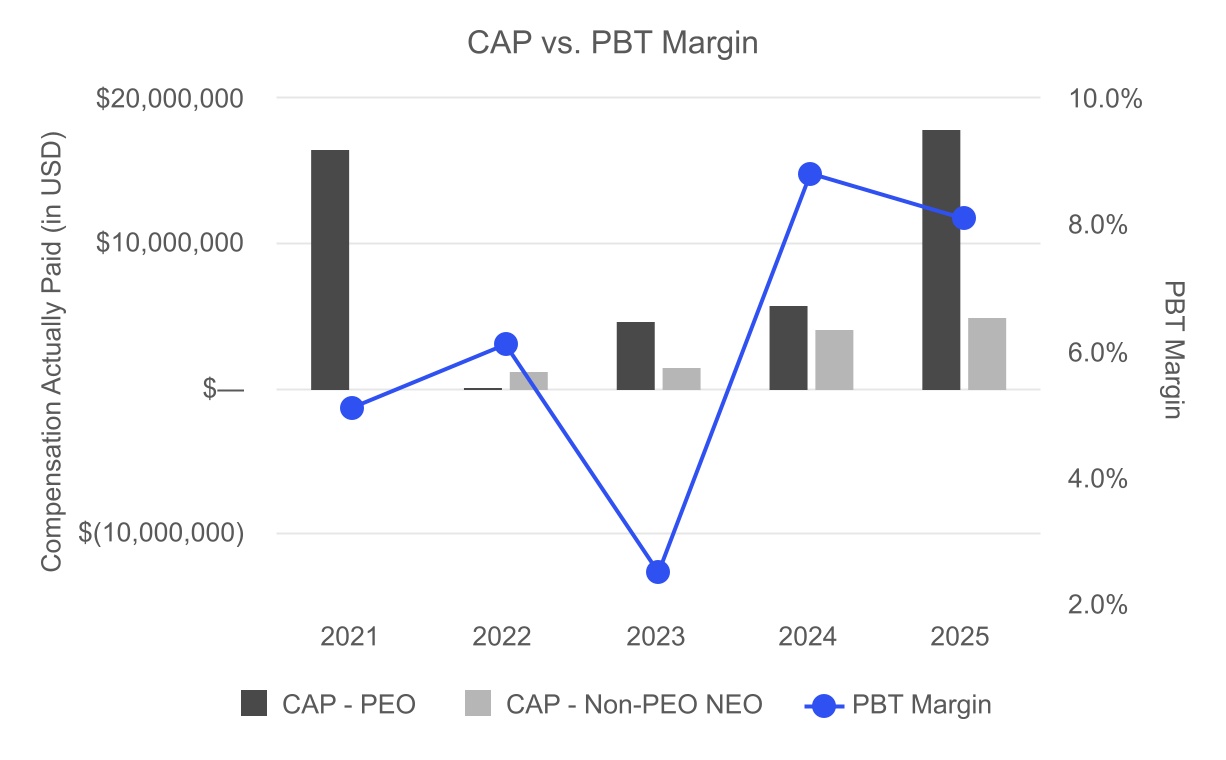
38
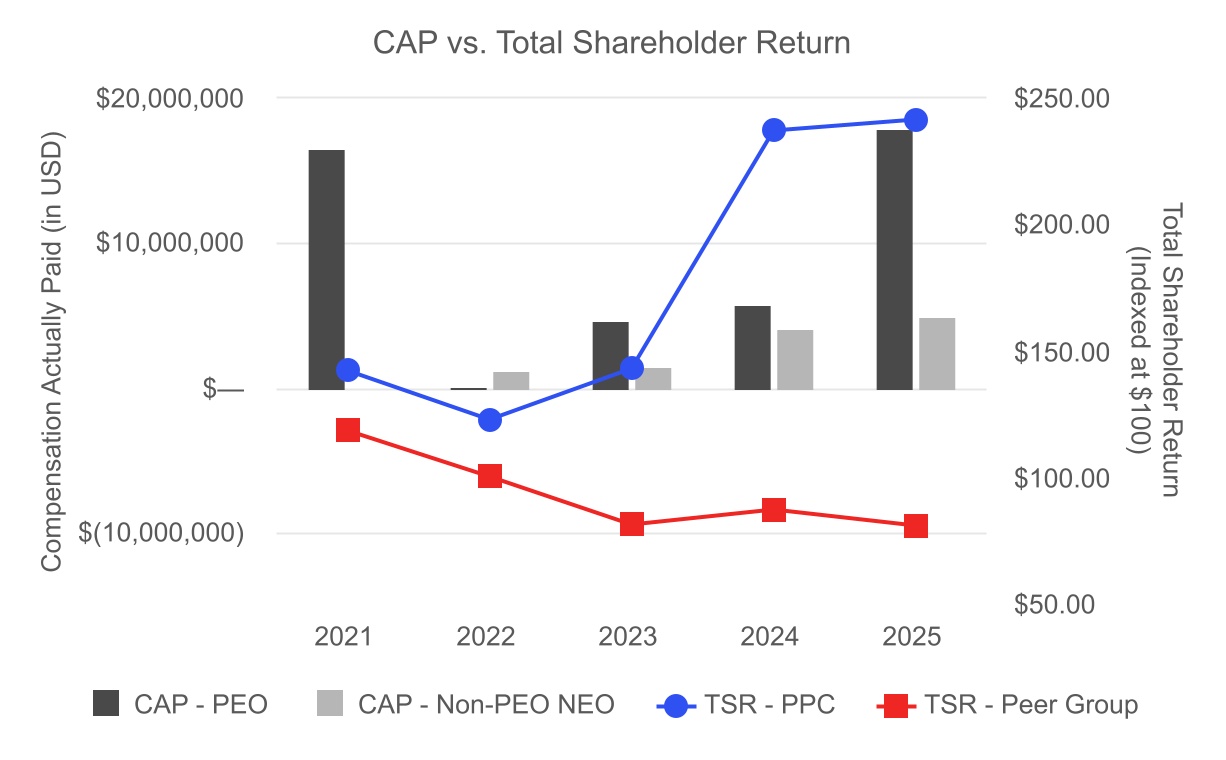
39
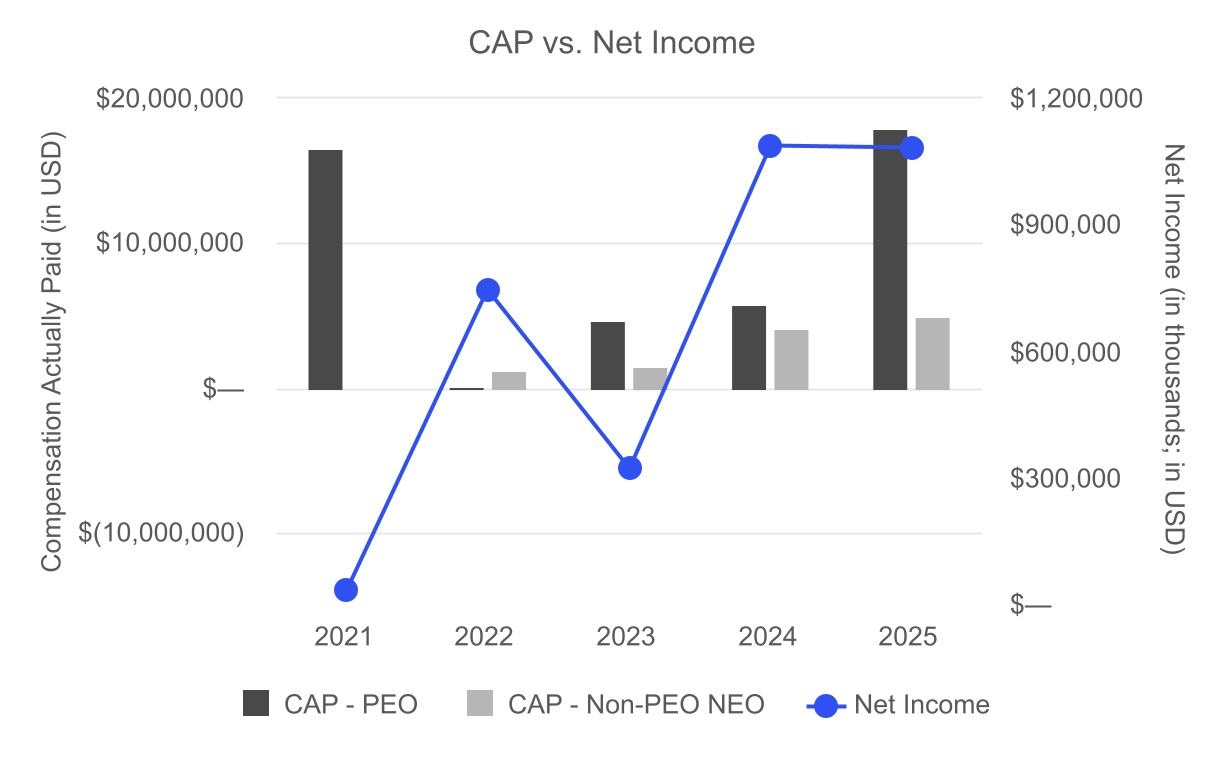
40
COMPENSATION RISKS
The Company has reviewed and assessed our compensation policies and practices to determine whether they are reasonably likely to have a material adverse effect on the Company. The Company’s management reviews compensation policies for the presence of certain elements that could encourage employees to take unnecessary or excessive risks; the ratios and level of incentive to fixed compensation, annual to long-term compensation and cash to equity compensation; and the comparison of compensation expense to earnings of the Company. Management’s assessment of the Company’s compensation policies is reviewed by the Compensation Committee as part of its risk oversight function.
The Company believes that its compensation programs for employees and executive officers are appropriately tailored to encourage employees to grow our business, but not to encourage them to do so in a way that poses unnecessary or excessive material risk. In particular, in 2025, the Company’s compensation programs were designed to provide the following:
•elements that balance short-term and long-term compensation;
•incentive compensation that rewards performance; and
•compensation with fixed and variable components.
As a result, the Company believes that executive officers and key employees receive a balance between competitive remuneration to encourage retention and compensation designed to provide opportunities to earn more by successfully executing our business strategy. The Company believes the design of these programs encourages our executive officers and key employees to perform at high levels and maximize Company performance without focusing exclusively on compensation performance metrics to the detriment of other important business metrics.
The Company also believes that its compensation program does not encourage excessive risk taking because the above compensation elements coupled with equity ownership in the Company provide a proper mix between long and short-term incentives. A significant portion of the NEOs’ total compensation is performance-based and tied to the profitability of the Company. Specifically, in 2025, Messrs. Sandri and Galvanoni were eligible to receive an annual cash bonus payable based on the Company’s PBT Margin. Additionally, Messrs. Sandri and Galvanoni have been granted equity awards and currently own a level of equity that the Company believes provides sufficient long-term incentives. The Company believes that the NEOs’ beneficial ownership of Pilgrim’s Pride common stock, which encourages long-term focus on sustainable performance, aligns their interests with those of our stockholders. For 2025, approximately 93.5% and 85.9% of the total target compensation of each of our CEO and CFO, respectively, was “at risk,” or dependent upon the Company’s performance.
Overall, the Company concluded that there were no risks arising from our compensation policies and practices that are reasonably likely to have a material adverse effect on the Company.
COMPENSATION COMMITTEE INTERLOCKS AND INSIDER PARTICIPATION
During 2025, the members of the Compensation Committee were Arquimedes Celis, Gilberto Tomazoni, and Andre Nogueira de Souza. No member of the Committee was, during 2025, an officer, former officer or employee of the Company or any of our subsidiaries. We did not have any compensation committee interlocks in 2025. See “Related Party Transactions - Reportable Transactions” for additional information on the Company’s transactions with JBS.
INSIDER TRADING POLICY
We have adopted insider trading policies and procedures governing the purchase, sale, and other dispositions of the Company’s securities by directors, officers, and employees that are reasonably designed to promote compliance with insider trading laws, rules and regulations (the “Insider Trading Policy”). For information on compensation-related aspects of this policy, see “Compensation Discussion and Analysis — Policy on Pledging” and “Compensation Discussion and Analysis — Policy on Hedging.” It is also the policy of the Company to comply with all applicable securities laws when transacting in its own securities. A copy of our Insider Trading Policy (as in effect as the date of the filing of the 2025 Annual Report) is attached as Exhibit 19.1 to the 2025 Annual Report.
41
DELINQUENT SECTION 16(A) REPORTS
Section 16(a) of the Exchange Act requires our officers and Directors, and persons who own more than ten percent of our common stock (“Reporting Persons”), to file reports of ownership and changes in ownership with the SEC. Based on a review of such reports filed with the SEC during the most recent fiscal year, our internal records and any written representations from Reporting Persons, we believe that the Reporting Persons complied with all Section 16(a) filing requirements applicable to our Reporting Persons for the fiscal year ended December 28, 2025, except for the following due to inadvertent administrative delays: two late Form 4s for Ms. Karoleski, reporting, on one such form, the acquisition of DEUs accrued on RSUs, and on the other, a grant of RSUs; three late Form 4s for each of Ms. Aslam and Messrs. J. Batista, W. Batista, Celis, Nogueira, Menon, Padilla, Tomazoni, and Vasconcellos, reporting, on two of such forms, the acquisition of DEUs accrued on RSUs, and on the third, a grant of RSUs; three late Form 4s for each of Messrs. Galvanoni and Sandri reporting, on two such forms, the acquisition of DEUs accrued on RSUs and PSUs, and on the third, the vesting of PSUs; and an additional late Form 4 for Mr. Sandri reporting the grant of an immediately-vesting RSU.
SECURITY OWNERSHIP
The following table sets forth certain information with respect to the beneficial ownership of our common stock by (1) each person known by us to own more than 5% of the outstanding shares of our common stock (the only class of voting securities outstanding); (2) each of our directors and director nominees; (3) our NEOs; and (4) all of our current Directors and executive officers as a group. The information below is provided as of March 19, 2026, unless otherwise indicated below.
Name and Beneficial Owner(a) | Amount and Nature of Beneficial Ownership of Common Stock | Percent of Outstanding Common Stock | Percent of Voting Power | |||||||||||||||||
Wesley Mendonça Batista(b) | 195,449,090 | 82.15 | % | 82.15 | % | |||||||||||||||
Joesley Mendonça Batista(b) | 195,449,090 | 82.15 | % | 82.15 | % | |||||||||||||||
JBS Wisconsin Properties, LLC(b) | 195,445,936 | 82.15 | % | 82.15 | % | |||||||||||||||
| Fabio Sandri | 70,237 | * | * | |||||||||||||||||
| Matthew Galvanoni | 28,135 | * | * | |||||||||||||||||
| Wallim Cruz de Vasconcellos Junior | 21,114 | * | * | |||||||||||||||||
| Farha Aslam | 17,825 | * | * | |||||||||||||||||
| Arquimedes A. Celis | 17,825 | * | * | |||||||||||||||||
| Joanita Karoleski | 8,617 | * | * | |||||||||||||||||
| Raul Padilla | 9,098 | * | * | |||||||||||||||||
| Gilberto Tomazoni | 3,154 | * | * | |||||||||||||||||
| Andre Nogueira de Souza | 3,154 | * | * | |||||||||||||||||
| Wesley Mendonça Batista Filho | — | * | * | |||||||||||||||||
All current executive officers, Directors, and Director nominees as a group (13 persons)(a) | 195,631,403 | 82.23 | % | 82.23 | % | |||||||||||||||
* Less than 1%.
(a)Unless otherwise noted, the address for each individual is c/o Pilgrim’s Pride Corporation, 1770 Promontory Circle, Greeley, CO 80634-9038. To our knowledge, except as otherwise indicated, each of the persons listed above has sole voting and investment power with respect to shares beneficially owned. The amounts reported for each of the individual Directors include the following shares of common stock underlying RSUs and related DEUs, which would vest upon their departure from the Board: for each of Messrs. Wesley and Joesley Batista, Tomazoni, and Nogueira: 3,154; for Mr. Vasconcellos, 21,114; for each of Ms. Aslam and Mr. Celis, 17,825; for Mr. Menon, 11,968; for Mr. Padilla, 9,098; for Ms. Karoleski, 1,151; for Mr. Batista Filho, none. The amounts reported for each of the individual executive officers include only previously vested RSUs and DEUs that have been converted into shares of common stock. There are no unvested RSUs and DEUs that will vest within 60 days of the record date for each of the individual executive officers.
(b)JBS Wisconsin Properties, LLC is a wholly owned, indirect subsidiary of JBS S.A. and directly beneficially owns 195,445,936 shares of our common stock. JBS S.A. is ultimately controlled by Joesley Mendonça Batista and Wesley Mendonça Batista, who jointly control and equally and indirectly own: (1) 100% of the equity interests in J&F Investimentos S.A., a Brazilian corporation, which owns approximately 23.54% of the outstanding capital of JBS S.A.; and (2) 100% of the equity interests in J&F Participações S.A., a Brazilian corporation, which owns approximately 24.79% of the outstanding capital of JBS S.A. The address of JBS S.A. is Avenida Marginal Direita do Tietê, 500, Bloco 1, 3rd Floor, City of São Paulo, State of São Paulo, Brazil, CEP 05118-100 and the address of JBS
42
Wisconsin Properties, LLC is 1770 Promontory Circle, Greeley, CO 80634-9038. The ownership of each of Messrs. Batista also includes shares of common stock underlying RSUs that will vest upon their departure from the Board.
RELATED PARTY TRANSACTIONS
Related Party Transactions Policy
During 2025, in accordance with its Charter, our Audit Committee was responsible for reviewing and approving the terms and conditions of all proposed transactions required to be disclosed under Item 404 of Regulation S-K, including transactions between us and any of our officers or Directors, or relatives or affiliates of any such officers or Directors. Furthermore, our Certificate of Incorporation provides that all transactions required to be disclosed under Item 404 of Regulation S-K under the Exchange Act (“related party transactions”) must first be reviewed, evaluated and approved by the Audit Committee or other committee comprised solely of independent directors, such approval to be evidenced by a resolution stating that such committee has, in good faith, unanimously determined that such transaction complies with the provisions of our Certificate of Incorporation governing related party transactions. Any Audit Committee or other independent body member who was or is not independent with respect to a related party transaction under review has been required by our Audit Committee Charter to disclose his or her lack of independence to the remaining committee members and abstain from the review and approval of that transactions. Under our Certificate of Incorporation, neither we nor any of our subsidiaries may enter into certain sale and purchase transactions with or for the benefit of JBS and its affiliates, except on fair and reasonable terms that are no less favorable to us and/or our applicable subsidiary than those that could have been obtained in a comparable arm’s-length transaction with an unrelated third party. Additionally, pursuant to our Governance Policies, we will not make significant charitable contributions to organizations in which a Director or his/her family member is affiliated, enter into consulting contracts with (or otherwise provide indirect forms of compensation to) a Director, or enter into transactions (other than service as a Director) with the Director or any business or nonprofit entity in which the director is a general partner, controlling stockholder, officer, manager, or trustee, or materially financially interested, without the prior approval of a majority of disinterested members of the full Board, and, if required by Nasdaq rules, the Audit Committee.
Reportable Transactions
Since December 30, 2024, the start of our fiscal year 2025, these transactions, along with all other related party transactions, received the approval of our Audit Committee. With the assistance of our management’s analysis, the Audit Committee reviewed the terms of all contracts entered into with related parties and determined that they were substantially similar to, and contained terms not less favorable to us than, those obtainable from unaffiliated parties.
The following are our related party transactions with amounts shown for the fiscal year 2025 (in thousands):
Expenditures paid by JBS USA Food Company on behalf of Pilgrim’s(a) | $ | 249,329 | |||
Expenditures paid by Pilgrim’s on behalf of JBS USA Food Company(a) | 12,931 | ||||
Sales to related parties(b) | 75,534 | ||||
Purchases from related parties(b) | 289,846 | ||||
(a)We have an agreement with JBS USA to allocate costs associated with JBS USA’s procurement of SAP licenses and maintenance services for both companies. Under this agreement, the fees associated with procuring SAP licenses and maintenance services are allocated between the Company and JBS USA in proportion to the percentage of licenses used by each company. The agreement expires on the date of expiration, or earlier termination, of the underlying SAP license agreement. We also have an agreement with JBS USA to allocate the costs of supporting the business operations by one consolidated corporate team, which have historically been supported by their respective corporate teams. Expenditures paid by JBS USA on behalf of PPC will be reimbursed by PPC and expenditures paid by PPC on behalf of JBS USA will be reimbursed by JBS USA. The current agreement expires on the earlier of either termination by either party or until the occurrence of any mechanism where JBS USA becomes 100% owner of PPC. Additionally, on December 30, 2024, we entered into a tax sharing agreement with JBS USA governing the allocation, and certain payment and reimbursement obligations of U.S. income tax liabilities and assets among the Company and its relevant U.S. corporate subsidiaries, on the one hand, and JBS USA and its relevant U.S. subsidiaries, on the other hand. Additionally, JBS USA will be required to make payments to the Company for the incremental tax cost savings to JBS USA arising from the planned consolidation with respect to any dividends paid by the Company on or after December 30, 2024, but prior to December 30, 2026, in the aggregate amount of up to $725.0 million. The agreement is effective for each tax year beginning on or after December 30, 2024 or such other date in which the Company becomes a member of the Parent Consolidated Group (as defined in the Tax Sharing Agreement).
43
(b)We routinely enter into transactions to sell our products to JBS USA and its subsidiaries and purchase products from them.
44
PROPOSAL 4. RATIFICATION OF THE APPOINTMENT OF INDEPENDENT REGISTERED PUBLIC ACCOUNTING FIRM
Our Board of Directors recommends the ratification of the appointment of KPMG LLP as our independent registered public accounting firm for 2026. If our stockholders fail to ratify the selection, it will be considered as notice to the Board and the Audit Committee to consider the selection of a different firm. Even if the selection is ratified, the Audit Committee, in its discretion, may select a different independent registered public accounting firm at any time during the year if it determines that such a change would be in the best interests of the Company and our stockholders. For information on the fees paid to KPMG LLP in fiscal years 2025 and 2024, see “Independent Registered Public Accounting Firm Fee Information.”
Representatives of KPMG LLP are expected to be present at the Annual Meeting and to be available to respond to appropriate questions. They will be given the opportunity to make a statement if they wish to do so.
Our Board of Directors recommends that you vote “FOR” the ratification of the appointment of KPMG LLP as our independent registered public accounting firm for 2026. Proxies will be so voted unless stockholders specify otherwise.
45
REPORT OF THE AUDIT COMMITTEE
The Audit Committee assists the Board in fulfilling its responsibilities for general oversight of the integrity of the Company’s financial statements, our compliance with legal and regulatory requirements, the independent registered public accounting firm’s qualifications and independence, the performance of our internal audit function and the independent registered public accounting firm, risk assessment and risk management. The Audit Committee manages the Company’s relationship with its independent registered public accounting firm (who reports directly to the Audit Committee). The Audit Committee has the authority to obtain advice and assistance from outside legal, accounting or other advisors as the Audit Committee deems necessary to carry out its duties and to receive appropriate funding, as determined by the Audit Committee, from the Company for such advice and assistance.
The Company’s management has primary responsibility for preparing our financial statements and for our financial reporting process. Our independent registered public accounting firm is responsible for auditing those annual financial statements and expressing an opinion on the conformity of the Company’s audited financial statements with U.S. GAAP. The Audit Committee’s responsibility is to monitor and review these processes and have direct responsibility for the appointment, compensation, retention and oversight of the independent registered public accounting firm retained to audit the Company’s financial statements, but not to verify independently the information provided to the Audit Committee.
In this context, the Audit Committee hereby reports as follows:
1. The Audit Committee has reviewed and discussed the audited financial statements with the Company’s management.
2. The Audit Committee has discussed with the independent registered public accounting firm the matters required to be discussed by the applicable requirements of the Public Company Accounting Oversight Board (the “PCAOB”) and the SEC.
3. The Audit Committee has received the written disclosures and the letter from the independent registered public accounting firm required by applicable requirements of the PCAOB regarding the independent registered public accounting firm’s communications with the Audit Committee concerning independence and has discussed with the independent registered public accounting firm the independent registered public accounting firm’s independence.
4. Based on the review and discussions set forth above, the Audit Committee recommended to the Board that the audited financial statements be included in the Company’s Annual Report on Form 10-K for the fiscal year ended December 28, 2025 for filing with the SEC.
The undersigned members of the Audit Committee have submitted this report to the Board of Directors.
| Audit Committee | |||||
| Wallim Cruz de Vasconcellos Jr, Chairman Farha Aslam Arquimedes Celis | |||||
46
INDEPENDENT REGISTERED PUBLIC ACCOUNTING FIRM FEE INFORMATION
The following table shows the aggregate fees for services rendered by KPMG LLP, the Company’s independent registered public accounting firm, for the fiscal years indicated:
| 2025 | 2024(d) | ||||||||||
Audit fees(a) | $ | 4,828,255 | $ | 4,795,113 | |||||||
Audit-related fees(b) | 150,377 | 179,051 | |||||||||
Tax fees(c) | 25,332 | 68,053 | |||||||||
| Total | $ | 5,003,964 | $ | 5,042,217 | |||||||
(a)Audit fees incurred are for the annual audit of the Company’s financial statements, the audit of internal controls over financial reporting (i.e., the Sarbanes-Oxley 404 Audit), the reviews of our quarterly reports on Form 10-Q, and statutory audits required in Mexico and the U.K. and Europe.
(b)Audit-related services principally include other attestation services such as agreed-upon procedures required for compliance with contracts or other statutes. For 2025, audit-related fees are primarily from work associated with Mexico social security law compliance reports, financial statement audits for tax purposes, and global ESG reports.
(c)Tax fees include services such as transfer pricing and foreign trade compliance procedures.
(d)Fee amounts for fiscal year 2024 have been updated from those previously reported to include fees related to sustainability reviews and statutory audits which were previously unreported.
The Audit Committee pre-approved all audit and non-audit fees of the independent registered public accounting firm during 2025 and 2024.
Pre-Approval Policies and Procedures
In accordance with its Charter, our Audit Committee has established policies and procedures by which it approves in advance any audit and permissible non-audit services to be provided by our independent registered public accounting firm. Under these procedures, prior to the engagement of the independent registered public accounting firm for pre-approved services, requests or applications for the independent registered public accounting firm to provide services must be submitted to our CFO, or his designee, and the Audit Committee and must include a detailed description of the services to be rendered. The CFO, or his designee, and the independent registered public accounting firm must ensure that the independent registered public accounting firm is not engaged to perform the proposed services unless those services are within the list of services that have received the Audit Committee’s pre-approval and must cause the Audit Committee to be informed in a timely manner of all services rendered by the independent registered public accounting firm and the related fees.
Requests or applications for the independent registered public accounting firm to provide services that require additions or revisions to the 2025 pre-approval will be submitted to the Audit Committee (or any Audit Committee members who have been delegated pre-approval authority) by the CFO or his designee. Each request or application must include:
•a recommendation by the CFO (or designee) as to whether the Audit Committee should approve the request or application; and
•a joint statement of the CFO (or designee) and the independent registered public accounting firm as to whether, in their view, the request or application is consistent with the SEC’s regulations and the requirements for auditor independence of the PCAOB.
The Audit Committee also will not permit the engagement to provide any services to the extent that the SEC has prohibited the provision of those services by independent registered public accounting firms.
The Audit Committee delegated authority to the Chairman of the Audit Committee to:
•pre-approve any services proposed to be provided by the independent registered public accounting firm and not already pre-approved or prohibited by this policy up to $25,000;
47
•increase any authorized fee limit for pre-approved services (but not by more than 30% of the initial amount that was pre-approved) before we or our subsidiaries engage the independent registered public accounting firm to perform services for any amount in excess of the fee limit; and
•investigate further the scope, necessity or advisability of any services as to which pre-approval is sought.
The Chairman of the Audit Committee is required to report any pre-approval or fee increase decisions to the Audit Committee at the following Audit Committee meeting.
PROPOSAL 5. STOCKHOLDER PROPOSAL TO PROVIDE A REPORT REGARDING INTERNAL DIVERSITY AND INCLUSION POLICIES AND PRACTICES
As You Sow, located at 11461 San Pablo Avenue, Suite 400, El Cerrito, CA 94530 (“As You Sow”), has advised us that it plans to introduce the following resolution. The Company will furnish to stockholders information regarding the shares of common stock purportedly owned by As You Sow promptly upon receiving an oral or written request for such information.
Stockholder Proposal
WHEREAS: Equity-based policies and programs that promote diversity and inclusion strengthen workforce effectiveness and corporate performance. Numerous studies have demonstrated the financial benefits of a diverse, inclusive workplace, while others demonstrate the risk of failing to establish human capital management policies that support and retain a diverse workforce:
•A McKinsey study found that companies with the strongest racial and ethnic diversity are 35% more likely to outperform their industry medians for earnings before interest and tax.1
•According to CEO Action for Inclusion & Diversity, “organizations that lead with inclusion are eight times more likely to have better business outcomes.” 2
•According to a recent CNBC survey, 80% of workers prefer to work for a company that values DEI.3
•A recent study by As You Sow of EEO-1 forms found a “positive association between diverse representation in management and positive financial performance.” 4
Pilgrim’s Pride is lagging its peers on diversity and inclusion policies and practices. Pilgrim’s Pride earned a 3% score on As You Sow’s Racial Justice Scorecard, compared with Tyson Foods’ 11% and General Mill’s 12%.5 The Company’s low score reflects minimal transparency on workforce data and its failure to disclose related human capital management policies and practices, as well as issues with workers’ rights and treatment.
Despite providing a general, public, diversity, equity, and inclusion statement, shareholders have a strong interest in gaining access to information about our Company’s internal diversity and inclusion policies and quantitative data demonstrating the effectiveness of those policies. Particularly important is the ability to understand whether they are sufficient to attract and retain the diverse talent critical to long-term success and avoid issues that create reputational harm or reduced financial performance.
As an example, in 2024, Pilgrim’s Pride faced serious reputational damage after reports of dangerous and abusive work conditions for undocumented workers facility.6 These issues signal weak internal accountability on related issues. The Company can improve its performance and reduce material risk by increasing transparency around its diversity and inclusion policies and practices.7
______________________
1 https://www.mckinsey.com/capabilities/people-and-organizational-performance/our-insights/delivering-through-diversity
2 https://www.ceoaction.com/purpose/
3 https://www.cnbc.com/2021/04/30/diversity-equity-and-inclusion-are-important-to-workers-survey-shows.html
48
4 Report — As You Sow
5 Racial Justice Data Visualization — As You Sow
6 https://www.business-humanrights.org/en/latest-news/usa-migrant-workers-incl-undocumented-workers-face-abusive-working-conditions-at-pilgrims-
prides-west-virginia-chicken-factory-incl-cos-comments/; https://mountainstatespotlight.org/2024/06/05/pilgrims-pride-moorefield-immigrant-workers/
7 https://assets.ctfassets.net/zedzgminpdhk/39LsaE4mJDD1AKxpHFBPU1/1fa1580944d02c15586b69a274276f07/PPC_Diversity EquityInclusion_Global_Policies_2.pdf
RESOLVED: Shareholders request that Pilgrim’s Pride issue a public report, at reasonable cost and omitting proprietary information, disclosing its internal diversity and inclusion policies and practices.
Recommendation of our Board of Directors
Our Board of Directors recommends that you vote “AGAINST” the stockholder proposal to provide a report regarding the Company’s internal diversity and inclusion policies and practices. Proxies will be so voted unless stockholders specify otherwise or withhold authority to vote.
PROPOSAL 6. STOCKHOLDER PROPOSAL TO PROVIDE A POLITICAL SPENDING DISCLOSURE
The Comptroller of the State of New York, located at 110 State Street Albany, NY 12236 (the “Comptroller”), has advised us that it plans to introduce the following resolution. The Company will furnish to stockholders information regarding the shares of common stock purportedly owned by the Comptroller promptly upon receiving an oral or written request for such information.
Stockholder Proposal
RESOLVED, that the shareholders of Pilgrim’s Pride Corporation (Pilgrim’s Pride or Company) hereby request that the Company provide a periodic report disclosing policies and procedures for making, and the identity of recipients, as well as the amount, of contributions or expenditures made from the Company’s corporate funds or assets to be used to (a) participate or intervene in any campaign on behalf of (or in opposition to) any candidate for public office, or (b) influence the general public, or any segment thereof, with respect to an election or referendum.
This proposal does not encompass lobbying spending.
Supporting Statement
Corporate participation in electoral politics carries significant regulatory, legal, and reputational risk that can be exacerbated by opacity.
Two of Pilgrim’s Pride’s board members, who are also controlling shareholders of the Company’s parent, have been subject of various legal and regulatory investigations - many of them ongoing. They have been personally implicated in allegations of corruption, bribery, and illegal political campaign contributions to more than 1,800 Brazilian politicians. In 2020, these Board members settled SEC charges of FCPA violations arising “out of an extensive bribery scheme that took place over multiple years.” The SEC stated that, “Engaging in bribery to finance their expansion into the U.S. markets and then continuing to engage in bribery while occupying senior board positions at Pilgrim’s reflects a profound failure to exercise good corporate governance.”
Pilgrim’s Pride was the largest single contributor to committee funding the January 2025 presidential inauguration, expending $5 million in corporate funds. Yet the company continues to face regulatory scrutiny, including President Trump directing the Department of Justice to “immediately begin an investigation” into meat packing companies citing “illicit Collusion, Price Fixing, and Price Manipulation” and singling out “Majority Foreign Owned Meat Packers.” Without periodic and complete disclosures, investors lack knowledge of the full extent to which corporate funds are being expended without benefiting the company.
The Company’s peers, including Conagra, Hormel, and Tyson, all provide disclosure of their election-related spending substantially consistent with this proposal. Pilgrim’s Pride, however, does not disclose its election-related spending in a comparable manner, making it a conspicuous outlier among its competitors and leaving its investors in the dark as to whether it’s effectively managing risks associated with political spending.
49
As long-term shareholders of Pilgrim’s Pride, we support transparency in corporate electoral spending. This includes any activity considered intervention in a political campaign under the Internal Revenue Code, such as direct and indirect contributions to political candidates, parties, or organizations, and independent expenditures or electioneering communications on behalf of federal, state, or local candidates.
We ask Pilgrim’s Pride to join its peers by disclosing its political spending, including payments to trade associations and other tax-exempt organizations which may be used for electoral purposes. Without this transparency, we cannot sufficiently assess whether the Company’s political spending addresses regulatory, legal and reputational risks consistent with its business strategy, corporate priorities, or other areas of concern.
Recommendation of our Board of Directors
Our Board of Directors recommends that you vote “AGAINST” the stockholder proposal to provide a political spending disclosure. Proxies will be so voted unless stockholders specify otherwise or withhold authority to vote.
50
HOUSEHOLDING OF STOCKHOLDER MATERIALS
Some banks, brokers and other nominee record holders may be participating in the practice of “householding” proxy statements and annual reports. This means that only one copy of this proxy statement or annual report to stockholders may have been sent to multiple stockholders in the same household. We will promptly deliver a separate copy of either document to any stockholder who requests orally or by writing to our Investor Relations Department at the following address: 1770 Promontory Circle, Greeley, Colorado 80634 or by telephone (970) 506-7783. Any stockholder who currently is receiving multiple copies and would like to receive only one copy for his or her household should contact his or her bank, broker or other nominee record holder.
STOCKHOLDER PROPOSALS FOR 2027 ANNUAL MEETING OF STOCKHOLDERS
Pursuant to our bylaws, a stockholder must give our Secretary timely written notice in order to present a proposal (including nominations of Directors) at the 2027 annual meeting of stockholders, which we intend to hold on April 28, 2027. Such written notice must contain specified information prescribed in our bylaws and must be received at our principal executive offices by December 29, 2026 (but not before August 1, 2026), and, if the stockholder seeks the inclusion of its director nominees on a universal proxy card, the notice must also contain the information required by Rules 14a-19(b)(2) and 14a-19(b)(3) of the Exchange Act (including a statement that the stockholder intends to solicit the holders of shares representing at least 67 percent of the voting power of shares entitled to vote on the election of directors in support of director nominees other than ours). Additionally, for stockholder proposals submitted pursuant to Rule 14a-8 of the Exchange Act to be considered for inclusion in the proxy materials for the 2027 annual meeting of stockholders, they must be received by our Secretary at our principal executive offices no later than the close of business on December 2, 2026.
ANNUAL REPORT
Our 2025 Annual Report is being mailed concurrently with this proxy statement. Upon written request of a stockholder, the Company will furnish without charge a copy of our 2025 Annual Report on Form 10-K, including the financial statements and financial statement schedules. If you would like to request a copy, please contact Pilgrim’s Pride Corporation, at: 1770 Promontory Circle, Greeley, Colorado 80634 Attn: Investor Relations.
In addition, our financial reports and recent filings with the SEC are available at www.sec.gov and on our website at ir.pilgrims.com. Information contained on our website is not part of this proxy statement.
IMPORTANT NOTICE REGARDING THE AVAILABILITY OF PROXY MATERIALS FOR THE STOCKHOLDER MEETING TO BE HELD ON April 29, 2026
This proxy statement and the Company’s 2025 Annual Report are also available electronically on our hosted website. You may view these directly at: www.proxyvote.com.
To access and review the materials made available electronically:
1.Go to www.proxyvote.com.
2.Enter the 16-digit control number located on the proxy card.
3.Click “Continue to Vote.”
We encourage you to review all of the important information contained in the proxy materials before voting.
51
OTHER BUSINESS
The Board of Directors is not aware of, and it is not anticipated that there will be presented at the Annual Meeting, any business other than the proposals included in this proxy statement. If other matters properly come before the Annual Meeting, the persons named on the accompanying proxy card will vote the returned proxies as the Board of Directors recommends.
| By order of the Board of Directors, | |||||||||||
| FABIO SANDRI | |||||||||||
| Greeley, Colorado | President and | ||||||||||
| April 1, 2026 | Chief Executive Officer | ||||||||||
52
Forward-Looking Statements
Statements contained in this press release that state the intentions, plans, hopes, beliefs, anticipations, expectations or predictions of the future of Pilgrim’s Pride Corporation and its management are considered forward-looking statements. Without limiting the foregoing, words such as “anticipates,” “believes,” “estimates,” “expects,” “intends,” “may,” “plans,” “projects,” “should,” “targets,” “will” and the negative thereof and similar words and expressions are intended to identify forward-looking statements. It is important to note that actual results could differ materially from those projected in such forward-looking statements. Factors that could cause actual results to differ materially from those projected in such forward-looking statements include: matters affecting the poultry industry generally; the ability to execute the Company’s business plan to achieve desired cost savings and profitability; future pricing for feed ingredients and the Company’s products; outbreaks of avian influenza or other diseases, either in Pilgrim’s Pride’s flocks or elsewhere, affecting its ability to conduct its operations and/or demand for its poultry products; contamination of Pilgrim’s Pride’s products, which has previously and can in the future lead to product liability claims and product recalls; exposure to risks related to product liability, product recalls, property damage and injuries to persons, for which insurance coverage is expensive, limited and potentially inadequate; management of cash resources; restrictions imposed by, and as a result of, Pilgrim’s Pride’s leverage; changes in laws or regulations affecting Pilgrim’s Pride’s operations or the application thereof; new immigration legislation or increased enforcement efforts in connection with existing immigration legislation that cause the costs of doing business to increase, cause Pilgrim’s Pride to change the way in which it does business, or otherwise disrupt its operations; competitive factors and pricing pressures or the loss of one or more of Pilgrim’s Pride’s largest customers; currency exchange rate fluctuations, trade barriers, exchange controls, expropriation and other risks associated with foreign operations; disruptions in international markets and distribution channels, including, but not limited to, the impacts of the Russia-Ukraine conflict; the risk of cyber-attacks, natural disasters, power losses, unauthorized access, telecommunication failures, and other problems on our information systems; and the impact of uncertainties of litigation and other legal matters described in our most recent Form 10-K and Form 10-Q, including the In re Broiler Chicken Antitrust Litigation, as well as other risks described under “Risk Factors” in the Company’s Annual Report on Form 10-K, Quarterly Reports on Form 10-Q and subsequent filings with the Securities and Exchange Commission. The forward-looking statements in this release speak only as of the date hereof, and the Company undertakes no obligation to update any such statement after the date of this proxy statement, whether as a result of new information, future developments or otherwise, except as may be required by applicable law.
53
Annex A
Reconciliation of GAAP Information to Non-GAAP Financial Measures
The following reconciles the GAAP information to the Non-GAAP financial measure included in this proxy statement for the fiscal year 2025:
| Reconciliation of Adjusted EBITDA | Amount | |||||||
| (In thousands) | ||||||||
| Net income | $ | 1,083,344 | ||||||
| Add: | ||||||||
| Interest expense, net | 110,270 | |||||||
| Income tax expense | 418,794 | |||||||
| Depreciation and amortization | 456,157 | |||||||
| EBITDA | 2,068,565 | |||||||
| Add: | ||||||||
| Foreign currency transaction losses | 6,777 | |||||||
| Litigation settlements | 162,659 | |||||||
| Restructuring activities losses | 31,354 | |||||||
| Minus: | ||||||||
| Net income attributable to noncontrolling interest | 985 | |||||||
| Adjusted EBITDA | $ | 2,268,370 | ||||||
The following table supports the PBT Margin calculation:
| Reconciliation of PBT Margin | 2025 | |||||||
| (In thousands, except percentage data) | ||||||||
| Income before tax, as reported | $ | 1,502,138 | ||||||
| Add: | ||||||||
| Litigation settlements | 162,659 | |||||||
| Income before tax, adjusted | 1,664,797 | |||||||
| Net sales | 18,497,553 | |||||||
| Income before tax, adjusted, as a percent of net sales | 9.0 | % | ||||||
54